
With Google and Apple yet to reach a conclusion on their request to export high-precision maps, an analysis has been raised that such an export could cause economic losses of up to 197 trillion won over the next 10 years. Academia and industry argued that conditions for fair competition between foreign and domestic companies must come first before allowing map exports.
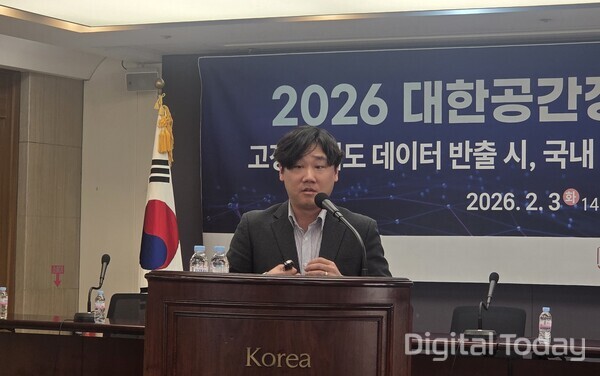
The Korea Spatial Information Society on Feb. 3 held an analysis forum at the Seoul Press Center on the economic impact on domestic industry of exporting high-precision map data overseas.
◆ Up to 197 trillion won loss over 10 years; "hard to export without preparation"
Professor Jeong Jin-do (정진도) of Korea National University of Education said in a presentation that an analysis using a computable general equilibrium (CGE) model found cumulative total costs from 2026 to 2035 would range from 150.68 trillion won in an optimistic case to 197.38 trillion won in a pessimistic case if maps are exported.
On an annual average basis, costs of 15 trillion to 19 trillion won would occur, with industrial damage accounting for the largest share at 13 trillion to 16 trillion won. The analysis also found royalty outflows not included in total costs would amount to an annual average of 6.3 trillion to 14.25 trillion won.
A notable point is that costs accumulate and accelerate over time. Jeong explained, "Right after export, there is no meaningful difference compared with maintaining the status quo, but around 2029 domestic industry damage and overseas leakage costs begin to surge, and after 2032 structural costs accelerate."
In particular, irreversible structural costs from dependence on overseas platforms and lock-in effects were cited as a problem. Jeong warned, "Structural losses that are hard to reverse accumulate and become entrenched over time," adding, "Innovation capacity and the ecosystem entry index also turn downward after 2029 to 2031, and the gap widens rapidly."
By industry, damage was concentrated in the spatial information and mapping sector and the digital platform sector. Jeong said, "In the two sectors, the pace of decline accelerates after 2029 to 2030, suggesting the possibility of a transition to structural, path-dependent encroachment."
Based on the analysis, Jeong presented five policy directions: securing interoperability, institutionalising fair competition among platforms, strengthening R&D and pre-empting standards, improving the industrial ecosystem, and building risk-management governance.
He said, "To offset the costs of map export, benefits of 21 trillion won a year in the optimistic case, 28 trillion won in the neutral case and 33 trillion won in the pessimistic case must occur." He added, "To resolve long-term economic risks, domestic investment and jobs, technology internalisation and the functioning of domestic alternative supply must be guaranteed."
Jeong concluded, "The costs of exporting high-precision maps overseas can return over time as irreversible structural costs," adding, "It should be allowed only after the five items are sufficiently prepared."
◆ Academia, industry: "Fair competition conditions such as installing domestic servers must be ensured"
A general discussion chaired by Professor Shin Dong-bin (신동빈) of Anyang University focused on securing conditions for fair competition. Discussants pointed to Google's refusal to accept a requirement to install domestic servers as a representative case raising concerns about unfair competition.
Senior research fellow Kim Dae-jong (김대종) of the Korea Research Institute for Human Settlements said, "Spatial information is related to survival and is not a subject for negotiation," adding, "Platforms have a lock-in effect as time goes by, so in the end there is no choice but to become dependent." He added, "If the value of spatial information is properly reflected in the input data, the economic damage will be much greater than the analysis results."
Principal research engineer Kim Ju-wan (김주완) of the Electronics and Telecommunications Research Institute said, "A 1:5,000 map is high-quality training data containing information on every corner of our country," adding, "If our high-precision maps are used to train Google's spatial information foundation model, an AI expert will be born that knows our country inside out."
Yoon Jun-hee (윤준희), a division head at the Korea Institute of Civil Engineering and Building Technology, said, "High-precision maps are not just data but national infrastructure," adding, "If map errors and update delays occur in disaster safety, they lead directly to accident costs and responsibility, so how far to leave it to overseas platforms is a national security issue."
Egis CEO Park Kwang-mok (박광목) introduced overseas cases, saying, "Taiwan set conditions for installing data centres inside the country and for controlling servers in a national emergency, and India, citing that terrorists used Google Maps in the 2008 Mumbai attacks, banned Street View filming until 2022."
Wavers CEO Park Chang-hoon (박창훈) said, "Small and medium-sized companies lack legal capacity, so if a risk arises due to security issues, they will have no choice but to close immediately," adding, "If you self-censor, you will eventually give up the service."
Ahn Jong-uk (안종욱), president of the Korea Spatial Information Society, said, "We plan to organise today's research results within the society and deliver a policy proposal to the Ministry of Land."
The discussion included Shin, Jeong and senior research fellow Kim, principal research engineer Kim, division head Yoon, Park of Egis, Park of Wavers, and All4Land managing director Hwang Jeong-rae (황정래).
 Lee Ho-jung
lhj@d-today.co.kr
Lee Ho-jung
lhj@d-today.co.kr