
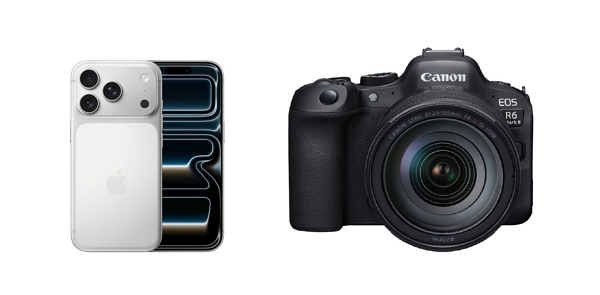
The iPhone 17 Pro camera has been found to show performance similar to a professional DSLR in some scenes thanks to software processing.
On Feb. 2, local time, IT outlet PhoneArena carried out a comparison test by shooting with a Canon R6 II and an iPhone 17 Pro under the same conditions. In the test, it fitted the Canon R6 II with a 24mm RF f/1.8 prime lens to match the iPhone’s angle of view. All photos were taken in auto mode with JPEG settings and analysed based on the output straight from the camera. The evaluation focused on real-world scene photos rather than lab charts or specifications.
In the results, Canon’s photos had darker, more realistic shadows, while the iPhone produced a bright, crisp tone thanks to HDR processing and colour correction. The iPhone showed warmer colours and stronger visual impact, and tended to capture clouds and fine scene elements better. Canon, by contrast, showed clear strengths in true-to-life colour and detail.
Differences also appeared in bokeh effects. Canon, with its full-frame sensor, rendered background blur and depth naturally, while the iPhone produced a similar effect through software-based processing. In some scenes, the iPhone’s HDR delivered stronger visual liveliness, while Canon produced photos strong in realism and fidelity to colour temperature. Differences in white balance and colour temperature also stood out clearly.
Differences also emerged in processing speed and convenience. The iPhone applies corrections and optimisation immediately after shooting, allowing users to check results right away. A DSLR takes more time because it requires post-processing of RAW files. As a result, in situations where fast sharing or social media use is important, the smartphone camera’s advantages stand out more.
But the most suitable device differs depending on the shooting purpose and use. For travel or everyday shooting, the iPhone has an advantage with HDR and colour correction. For cases where colour reproduction and detail matter, such as advertising shoots or high-resolution photos for print, a DSLR is more suitable. Experts said, "Since the two devices are tools aimed at different uses, it is important to understand their strengths and weaknesses and use them appropriately for the situation rather than making a simple comparison."
In conclusion, the test showed that the latest smartphone cameras have performance that can compete with high-end DSLRs in some scenes. It also confirmed that DSLRs still have an advantage in sensor size, lens choice and post-processing flexibility. Ultimately, it is important for users to choose the right device by considering shooting purpose and convenience, and it shows that technological advances continue to expand the range of smartphone camera use.
 Kyung-min Hong (홍경민)
hongm@d-today.co.kr
Kyung-min Hong (홍경민)
hongm@d-today.co.kr