
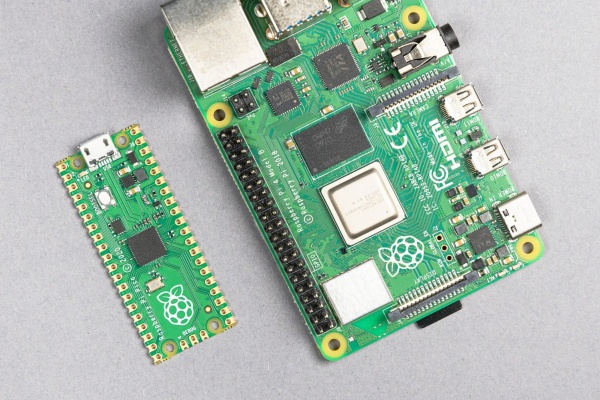
As a shortage of memory and storage chips triggered by the artificial intelligence (AI) boom spreads across the broader PC components market, Raspberry Pi has implemented another price increase after two months. The surge in memory prices is directly hitting the single-board computer (SBC) market. The situation is expected to likely continue through this year and into next year.
According to IT outlet Ars Technica on Feb. 2 (local time), Raspberry Pi CEO Eben Upton (에번 업튼) recently said some memory component prices rose more than twofold over the past quarter. He announced additional price increases for the Raspberry Pi lineup equipped with 2GB or more of memory. The increase applies to Raspberry Pi 4 and 5, Compute Module 4 and 5, and the Raspberry Pi 500, a keyboard-integrated model.
Specifically, the 2GB model will rise by $10 (about 14,500 won), the 4GB model by $15 (about 21,760 won), the 8GB model by $30 (about 43,530 won) and the 16GB model by $60 (about 87,050 won). With the adjustment, the 16GB Raspberry Pi 5 will reach $205 (about 300,000 won). The 8GB Raspberry Pi 4 and 5 models will be priced at $125 (about 180,000 won) and $135 (about 190,000 won), respectively, exceeding $100 (about 145,000 won). This is an additional move after price increases of $5 to $25 (about 7,200 to 36,200 won) implemented in October and December last year.
Not all products are affected. The Raspberry Pi 4 and 5 models with 1GB of memory will keep their existing prices of $35 (about 50,000 won) and $45 (about 65,000 won). The Raspberry Pi 400 and older Raspberry Pi 3 and Zero series models that use LPDDR2 memory are also excluded from the increase. Upton said the company has secured sufficient LPDDR2 memory inventory, allowing it to keep prices unchanged for those products.
Raspberry Pi has grown as a platform targeting the maker and education markets with a low price around $35. Its ecosystem, built on an operating system (OS), applications and a range of open-source projects, has been a strength. But as prices have surged recently, some users are citing x86-based mini PCs or used PCs as alternatives. During the supply crunch in 2022 to 2023, more cases emerged of choosing older thin client PCs for simple projects.
Upton made clear he would roll back the price increases if the memory market normalises. He said the current situation is a temporary issue and that the higher prices would be reversed when memory prices stabilise. He added the memory pricing environment could remain challenging until 2026, offering a cautious outlook on a near-term normalisation.
 Jinju Hong
hongjj@d-today.co.kr
Jinju Hong
hongjj@d-today.co.kr