
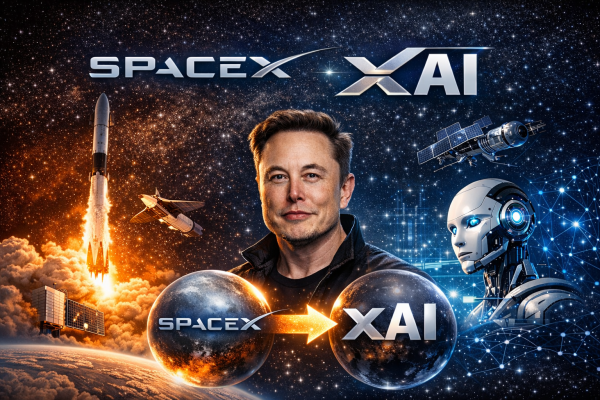
[DigitalToday reporter Jinju Hong] SpaceX, the space company led by Elon Musk (일론 머스크), Tesla’s chief executive, has acquired AI startup xAI ahead of an initial public offering (IPO).
On Feb. 2 (local time), major foreign media including electric vehicle outlet Electrek reported that Musk posted a memo on SpaceX’s official website titled “xAI joins SpaceX to advance the future of humanity.” The transaction was carried out by establishing an integrated entity valued at about $1.25 trillion. Tesla, which invested $2 billion in xAI last month, was not included as an acquirer.
In a blog post, Musk described the integrated SpaceX-xAI entity as “the most ambitious and vertically integrated innovation engine on and off Earth combining AI, rockets, space-based internet, direct communication between mobile devices, real-time information and a free-speech platform.”
The acquisition combines SpaceX, valued at about $800 billion, with xAI, which has recently been given a corporate valuation of more than $200 billion. On Wall Street, there is a view that the merged entity could push for an IPO of up to $50 billion by the end of this year.
Musk’s long-term plan is to build a satellite network of up to 1 million “orbital data centre” units that carry out AI computing using solar energy in space. SpaceX applied to the U.S. Federal Communications Commission (FCC) last week for permission to launch the satellites. Musk claimed it would become a way to produce AI computing at the lowest cost in space within 2 to 3 years.
The market is focusing on the impact of the deal on Tesla. Among Tesla investors, controversy is growing over the meaning of the $2 billion invested in xAI. That investment is now converted into an indirect stake in the integrated SpaceX-xAI entity, and as a result Tesla shareholders will hold a minority stake in the unlisted company SpaceX.
Early in the merger, the possibility of a three-way integration including Tesla was also mentioned, but it did not materialise because of the legal and structural complexity of merging a listed company, Tesla, with an unlisted entity. As a result, Musk’s business empire was more clearly divided into two pillars: SpaceX, xAI and X (space, AI and social media), and Tesla (automobiles, energy and robotics).
The question is which side will draw more of Musk’s attention and resources. The market is concerned that cash flow is moving one way from Tesla to Musk’s unlisted companies. Tesla put large-scale funds into xAI on the pretext of securing AI talent and technology, but while SpaceX has already secured a stable revenue base, xAI is burning substantial cash as it competes with OpenAI, Google and Anthropic.
By integrating SpaceX and xAI, Musk has been able to support xAI’s AI development using SpaceX’s profitability, while also providing an exit strategy for xAI investors through a future IPO.
However, conflict-of-interest controversy has not been resolved. Tesla shareholders have filed lawsuits alleging a breach of fiduciary duty, saying Musk used Tesla’s funds to support private companies. Musk holds about an 18 percent stake in Tesla and a 42 percent stake in SpaceX (79 percent of voting rights), and he also controls xAI. There is criticism that moving funds between these entities could structurally work to Musk’s personal advantage.
Electrek assessed the deal by saying, “Musk rescued xAI, a social media and AI company that has fallen behind in the competition.” It said the analysis is that this is a repeat of the case that caused controversy when Tesla acquired SolarCity in 2016.
It added, “It has not yet been verified whether space-based AI can bring tangible benefits to humanity,” and said, “What is clear is that the CEO of Tesla, which has recorded declines in car sales for 2 consecutive years, is running another giant company competing with Tesla for the same AI talent and resources.” It also added that, because funds from a listed company rather than personal funds are being injected, there is an assessment that this decision is far from the signal of trust investors had expected.
 Jinju Hong
hongjj@d-today.co.kr
Jinju Hong
hongjj@d-today.co.kr