
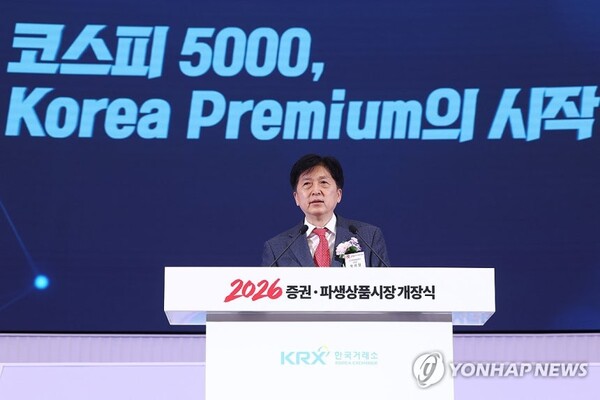
Ruling party lawmakers pledged legislative and policy support to go beyond addressing the so-called Korea discount and move toward a Korea premium era.
At the 'KOSPI 5000 and Beyond' event held on Feb. 3 at the Korea Exchange in Seoul's Yeouido district, Rep. Kang Jun-hyeon (강준현) of the Democratic Party and Oh Ki-hyung (오기형), chairman of the party's special committee on revitalising K-capital markets, delivered congratulatory remarks.
Kang said that until recently South Korea's capital market had been mired in a Korea discount due to political turmoil and instability in state affairs. He said a new government had broken that link by separating politics from the market and restoring economic order through predictable state management.
Kang particularly stressed the National Assembly's legislative efforts.
He said governance became more transparent and unfair trading was blocked through revisions to the Commercial Act and the Capital Markets Act, changing the market's rules. Global money, he said, comes in not by looking at simple numbers but by looking at the rules of a fair market and a country that can be trusted.
Oh said the KOSPI 5000 era had opened but there was still a long way to go. He called for consistently pushing policies to move beyond the Korea discount to a Korea premium era.
Oh cited Japan's case to stress policy continuity.
He said Japan pursued consistent value-up policies for 10 years and the Nikkei index rose more than threefold. He said South Korea, by contrast, saw past value-up policies halted after six months, giving rise to cynical talk of "escaping" the domestic stock market.
He added that capital market policy is not a matter of conservatism or progressivism but of market normalisation. He said the market must gain trust through consistent policies that last 5 or 10 years regardless of the administration.
Oh also set out his conviction on revisions to the Commercial Act and changes in corporate management practices.
He said there was criticism during the first and second rounds of Commercial Act revisions that they were "anti-business", but the actual market reaction was "pro-market". He said the third round now under discussion also aligns with board-centered governance.
He also said controversies remain over alleged infringements of ordinary shareholders' interests, including recent treasury stock disposals and duplicate listings. He said boards must consider proportional benefits for shareholders and institutional investors must also play an active role through shareholders' meetings to achieve a Korea premium.
 Sang-yeop Oh
yub@d-today.co.kr
Sang-yeop Oh
yub@d-today.co.kr