
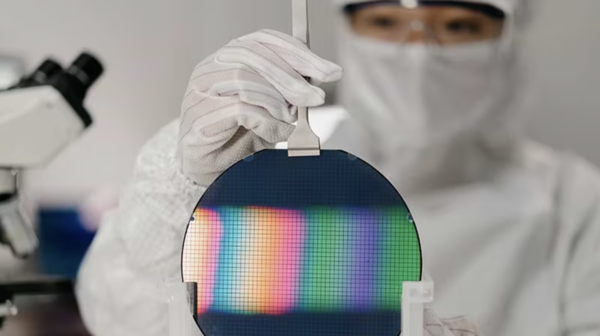
The January jinx for semiconductor exports has been broken. January semiconductor exports surged 102.7 percent from a year earlier to $20.54 billion, exceeding $20 billion for a second straight month. The Ministry of Trade, Industry and Energy said demand seasonality has faded due to investment in artificial intelligence (AI) data centres, undermining the usual January slack-season pattern. Semiconductors accounted for 32.2 percent of total exports of $65.85 billion.
January has traditionally been a slow season for the semiconductor industry, as fewer working days and the Lunar New Year holiday follow export concentration at year-end. This year was different. After $20.8 billion in December last year, exports came in at $20.5 billion in January, the second-highest on record. It was the 10th straight month of a record high for that month. This is interpreted as a sign that the structure of semiconductor demand itself has changed, rather than a simple increase in exports.
The key driver lifting export values even in the off-season was a sharp rise in memory chip prices. Compared with January last year, the average fixed price in January for DDR4 (8 gigabytes), a general-purpose DRAM product, jumped 8.5 times to $11.5 from $1.35. DDR5 (16GB) rose 7.6 times to $28.5 from $3.75, and NAND flash (128GB) climbed 4.3 times to $9.46 from $2.18. The price surge pushed export values up sharply.
Behind the price jump is a surge in demand for AI servers. Data centre investment by big tech companies continued regardless of quarterly seasonal factors, keeping demand for high-capacity memory firm. It also coincided with the impact of production cuts by Samsung Electronics and SK Hynix that have continued since last year, deepening supply shortages. In a demand structure centred on PCs and smartphones, first-quarter inventory adjustments were unavoidable, but AI infrastructure investment fully offset that.
The disappearance of seasonality that divided peak and off-seasons is also evident in the regional export structure. Exports to China rose 46.7 percent to $13.5 billion, while exports to ASEAN increased 40.7 percent to a record $12.11 billion, surpassing the United States at $12.02 billion. The Ministry of Trade, Industry and Energy said semiconductors drove export growth in both regions. Unlike past Januaries, when exports plunged as factories in China shut during the Lunar New Year, AI data centre investment neutralised seasonal factors by region this year.
Exports to the United States also rose 29.5 percent, but the details are complex. Semiconductor exports surged 169 percent, but tariff-affected items that had been key export products, such as automobiles, which fell 12.6 percent, and general machinery, which dropped 34.2 percent, were weak. It means tariffs imposed by the Trump administration are hitting exports of key items such as cars and machinery, while semiconductors are cushioning the impact.
Tariff risks leave semiconductors alone up 169 percent as an export 'shield'
The era of $20 billion semiconductor exports can be seen as an indicator of the high-bandwidth memory (HBM) competitiveness of Samsung Electronics and SK Hynix. The two companies are leading the global market in HBM, which is essential for AI servers. In particular, SK Hynix has continued strong performance with supplies of HBM3E to Nvidia, and Samsung Electronics is also moving to expand HBM3E supply. It also has HBM4 supply, to be used in next-generation GPUs, in sight.
The key issue is a U.S.-driven semiconductor item tariff policy that will soon take concrete shape. The industry expects robust semiconductor exports to continue through the first half on sustained AI infrastructure investment, but export growth could be braked if the tariff impact takes hold in earnest after the second quarter. On this, Trade Minister Kim Jung-kwan (김정관) said, "We will continue consultations with the United States with national interests as the top priority." Concerns are also being raised over whether the sharp jump in DRAM prices that lifted export values is sustainable. An industry official said, "The current price increase may be a temporary phenomenon due to supply shortages."
 Seok Dae-geon
d2dg@d-today.co.kr
Seok Dae-geon
d2dg@d-today.co.kr