
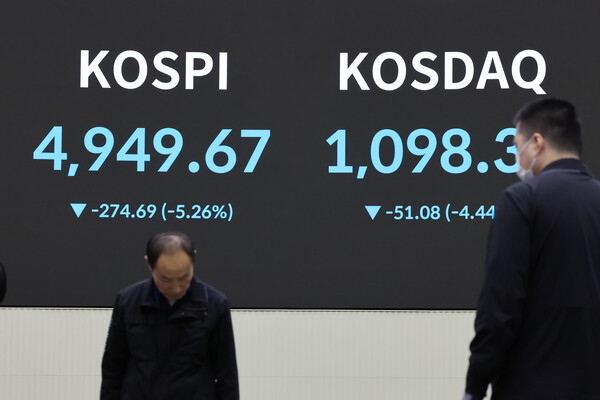
The KOSPI, which had been setting fresh record highs day after day, sank more than 5 percent and broke below the 5,000 mark. Analysts say a market phase of “asset coupling”, in which safe-haven and risk assets rose together in an unusual move, has ended, and fears of a broad, simultaneous sell-off have swept the market.
The KOSPI ended down 5.26 percent from the previous session at 4,949.67, breaking below 5,000, according to the Korea Exchange on Monday. The market triggered its first sell-sidecar of the year, and major assets such as gold, silver and bitcoin also fell in tandem.
The “joint rise” trend that dominated the market through January quickly turned into “chain selling”, complicating investors' calculations.
Up to last month, financial markets saw an unusual phenomenon in which safe-haven assets (gold and silver) and risk assets (bitcoin and stocks), which have opposite characteristics, rose together. A combination of factors lay behind the move, as these assets, which usually move in opposite directions, climbed side by side.
First, geopolitical risks fuelled demand for safe-haven assets. Ongoing instability in the Middle East, including a war crisis involving Iran, pushed gold and silver to repeated record highs.
At the same time, expectations of U.S. Federal Reserve rate cuts and abundant liquidity lifted risk assets such as bitcoin and the stock market. Broad gains were driven by a form of “dual buying”, with investors buying gold out of anxiety and buying stocks on expectations that liquidity would be released.
But the situation changed abruptly after U.S. President Trump nominated former Fed governor Kevin Warsh, seen as hawkish, as the next Fed chair. Fears that the liquidity party markets had expected could end spread into a “Wash shock”, hitting asset markets broadly.
As the dollar rapidly turned stronger, commodities and digital assets were hit hard. Silver futures plunged 31 percent over the weekend, marking the biggest drop since 1980. Gold fell more than 11 percent in a single day, and bitcoin slid to the $70,000 level for the first time in 9 months.
Experts cite a chain reaction of margin calls as the main cause of the joint rout. As futures exchanges raised margin rates on the grounds of rising volatility, including lifting silver futures margins from 9 percent to 11 percent, investors sold both profitable and loss-making assets to raise cash, widening the declines, analysts said.
The domestic stock market did not escape the shock. The KOSPI broke below 5,000 amid heavy selling by foreigners and institutions. In the futures market, a drop of more than 5 percent persisted for 1 minute, triggering the first sell-sidecar of the year. Big semiconductor stocks led the slump, including Samsung Electronics, down 6.29 percent, and SK Hynix, down 8.69 percent.
Still, brokerages see the plunge as a process of easing short-term overheating rather than a trend-driven decline.
Samsung Securities analysed that even if Warsh takes office, it would be difficult to carry out sharp tightening, and that the KOSPI's 12-month forward price-to-book ratio stands at 1.46, leaving undervaluation appeal intact.
The phase after the broad rally ends is likely to become a “selective rally” in which winners and losers are sorted out. Experts suggest February stock market strategies of managing volatility, reducing leverage and defending against currency moves.
As seen in the silver futures crash, excessive leverage investment can be fatal in a period of rising volatility. In particular, products that track moves by 2 times or 3 times, such as exchange-traded notes, can sharply raise the risk of principal loss when the underlying asset plunges, making it necessary to cut exposure.
The dollar's strength could persist for some time, so investors should carefully weigh whether to hedge currency risk. Currency-unhedged products may be advantageous for overseas stocks or commodity investments, but in periods of extreme volatility, exchange-rate swings can distort returns and require caution.
Euntaek Lee (이은택), a researcher at KB Securities, said profit-taking demand could grow in assets that surged after Warsh's nomination and forecast that a volatile market could continue for the time being.
Ain Cho (조아인), a researcher at Samsung Securities, also said stock market volatility could widen in the short term, increasing the difficulty of investing. But she forecast that in the medium to long term, the Fed's policy credibility and independence would be restored, creating a favourable environment for the stock market.
 Sangyeop Oh
yub@d-today.co.kr
Sangyeop Oh
yub@d-today.co.kr