
China's Ant Group is drawing industry attention by open-sourcing a robot artificial intelligence (AI) model for the first time as it seeks to bring robots out of the laboratory and into real-world settings.
On Jan. 30 local time, the Hong Kong South China Morning Post (SCMP) said the open-source release is expected to further accelerate competition in 'embodied intelligence', where systems perceive, reason and act in physical environments beyond the digital domain.
According to the report, Hangzhou-headquartered Ant Group is stepping up its push into 'embodied intelligence', an AI system designed to perceive, reason and act in physical environments rather than purely digital settings. Ant, the fintech affiliate of Alibaba Group Holding, unveiled LingBot-VLA, a vision-language-action (VLA) model that supports a robot's 'universal brain', through its robotics unit Ant Lingbo Technology (Robbyant). It explained that the goal is to enable broader, more scalable and practical deployment across industry.
Zhu Xing (주싱), chief executive of Robbyant, said that embodied intelligence needs a high-performance, low-cost foundation model that runs reliably on real hardware to spread at scale. He said the goal is to speed up AI integration into the physical world and deliver practical value faster.
China is seen as a global leader in the rollout of industrial and humanoid robots. But critics have said that even when some humanoids, such as those from Unitree Robotics, demonstrate dances or flips, they often rely on pre-programmed routines, limiting autonomy and general-purpose task performance. As a result, improving the 'robot brain' linked to real productivity has emerged as a key task for the industry.
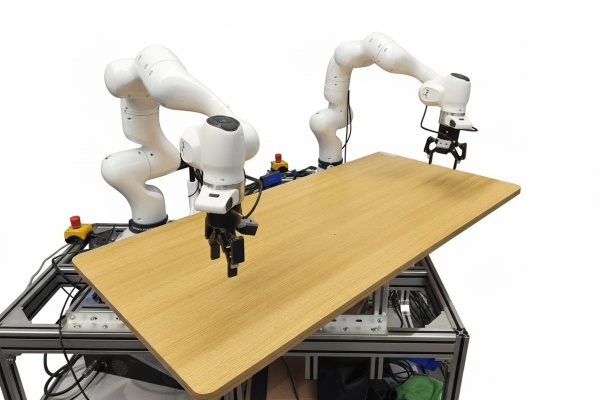
In technical documents, Ant said LingBot-VLA was tested on equipment including AgiBot's dual-arm robot and systems from Galaxea Dynamics and AgileX Robotics. It said that across 100 tasks, including opening a bottle cap, mounting plates on a dumbbell and peeling a lemon, generalisation performance and learning efficiency improved compared with other VLA models. It also acknowledged that real robot data is a bottleneck. Ant added that while it trained on about 20,000 hours of real-world data, it remained at a level similar to U.S. startup Physical Intelligence's VLA model PI*0.6, and that more data is needed for a 'platform-agnostic universal brain'.
As an alternative to ease data shortages, the industry has pointed to 'world models', where robots learn and practise in virtual environments. Ant also unveiled its first world model, LingBot-World, saying it offers capabilities at a level similar to Genie 3, which is known as an industry-leading system from Google DeepMind. Ant thereby joined the ranks of China's big tech companies entering competition in world model-based embodied intelligence, alongside Tencent and SenseTime.
Industry observers say open-sourcing could speed the spread of the robot software ecosystem and serve as a catalyst to bring forward deployment in industrial settings. But challenges remain, including the need to ensure stable operation on real hardware and expand data, without which it would be difficult to lower the barrier to field deployment.
 Yoonseo Lee
yslee@d-today.co.kr
Yoonseo Lee
yslee@d-today.co.kr