
[DigitalToday reporter Daegeon Seok] Samsung SDI halved its deficit in the fourth quarter of last year, helped by record-high sales of batteries for energy storage systems and higher benefits from U.S. tax credits.
Samsung SDI said on Feb. 2 it posted fourth-quarter 2025 revenue of 3.86 trillion won and an operating loss of 299.2 billion won. Revenue rose 26.4 percent from the previous quarter and 2.8 percent from a year earlier. The deficit narrowed to about half the previous quarter. The company posted its highest-ever quarterly sales in its ESS battery business. Benefits from the U.S. advanced manufacturing production tax credit (AMPC) also increased, and compensation related to lower electric vehicle battery volumes was reflected.
As a result, battery segment revenue rose 28.4 percent from the previous quarter to 3.62 trillion won. The operating loss was 338.5 billion won. The electronic materials segment posted revenue of 236.7 billion won and operating profit of 39.3 billion won, staying at a similar level to the previous quarter.
Full-year results for last year were revenue of 13.27 trillion won and an operating loss of 1.72 trillion won. Changes in eco-friendly policies and reduced electric vehicle sales by a strategic U.S. customer had an impact, and the recovery in demand for small batteries was also delayed, the company explained.
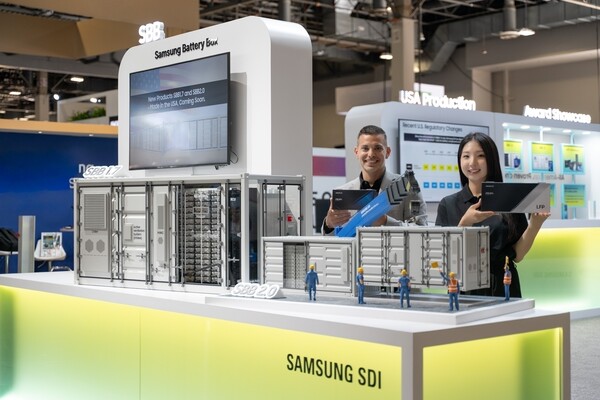
It was assessed that the company delivered some results even amid losses. Samsung SDI, the only non-Chinese prismatic battery maker, diversified its portfolio with the NCA-based SBB 1.7 and the LFP-based SBB 2.0. It expanded ESS battery production capacity in the United States.
It also strengthened cooperation to secure future technologies. It signed a joint business agreement with BMW for all-solid-state battery demonstration. It also signed an MOU with Hyundai Motor-Kia to jointly develop robot-dedicated batteries.
It delivered order wins for mid- to long-term growth. It completed orders for NCA 46-pi cylindrical batteries for major automaker customers. It signed a large supply contract for ESS LFP prismatic batteries. It also secured a large volume of orders in South Korea's first central contract market for ESS. It launched tabless ultra-high-output cylindrical batteries and began supplying them to global power tool customers.
Samsung SDI said the global electric vehicle battery market excluding China is expected to grow about 6 percent this year. It cited easing eco-friendly policies in North America and Europe. It also expects adjustments to electrification strategies by major global automakers to have an impact.
The company expects the ESS battery market to grow as investment spreads in AI data centers. Demand continues to rise for power applications, uninterruptible power supply (UPS) systems and battery backup units (BBU). In particular, it expects supply opportunities to expand as non-Chinese companies produce locally in the United States. The small battery market is expected to see a rebound in demand led by professional power tools, while demand in new markets such as robots is also expected to keep growing, the company said.
Samsung SDI set strengthening technological competitiveness and improving its business structure as its core strategy. For ESS batteries, it plans to run capacity at full utilization and maximize profitability improvement through local mass production of SBB 2.0 in the United States. For electric vehicle batteries, it will improve performance based on sales to new customers and expand orders for new products such as LFP and mid-nickel. It will also pursue orders for hybrid electric vehicle projects using tabless ultra-high-output cylindrical batteries.
A Samsung SDI official said, "Through selective focus for management efficiency, faster response to customers and markets, and preparation for future technologies, we will make this year the first year of a turnaround."
 Daegeon Seok
d2dg@d-today.co.kr
Daegeon Seok
d2dg@d-today.co.kr