
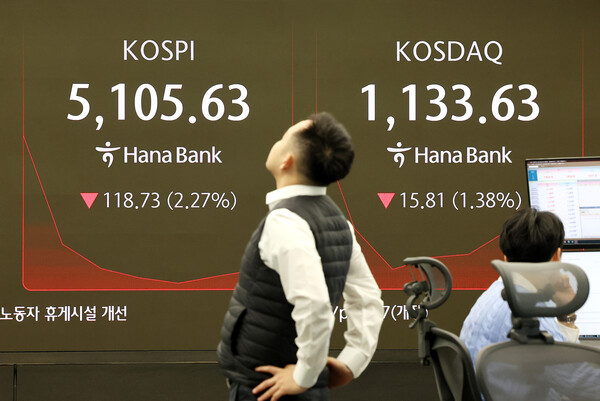
[DigitalToday reporter Sangyeop Oh] The KOSPI briefly gave up the 5,000 level during the session on negative news from the United States.
On Feb. 2, the KOSPI opened down 1.95 percent at 5,122.62. It then briefly broke below 5,100, falling more than 2 percent to as low as 5,083.51. As of 9:15 a.m., it was trading down 1.01 percent at 5,171.63.
Behind the slide is a broader pullback in U.S. stocks. On Feb. 1, U.S. time, the Dow Jones Industrial Average fell 0.36 percent on the New York Stock Exchange. The S&P 500 and the Nasdaq also dropped 0.43 percent and 0.94 percent, with all three major indexes ending lower.
In the market, analysts say a sharp drop in commodity prices that had surged recently was the direct trigger. Silver prices plunged more than 30 percent in a single day, and international gold prices fell about 10 percent, increasing volatility.
Silver prices had been lifted by expectations of rising demand for power equipment as artificial intelligence infrastructure spreads. The latest plunge is therefore interpreted as coinciding with a recalibration of expectations for the broader AI industry.
Uncertainty related to AI also added to the burden on stocks. Market participants say scepticism about the pace and profitability of expanded AI investment has resurfaced after Microsoft released results that fell short of market expectations.
Caution over monetary policy also continued. Concerns that the timing of interest rate cuts could be delayed were reflected in the market after Kevin Warsh, a former U.S. Federal Reserve governor classified as hawkish, was named as a candidate for the next Fed chair.
With these U.S. stock market conditions combining with a stronger dollar and a sharp drop in commodity prices, South Korea's stock market is also expected to face heavy downside pressure.
 Sangyeop Oh
yub@d-today.co.kr
Sangyeop Oh
yub@d-today.co.kr