
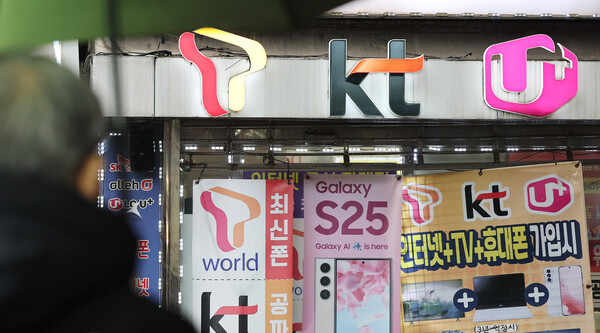
[DigitalToday reporter Jin-ho Lee (이진호)] South Korea's three mobile carriers are expected to recover combined annual operating profit to the 4 trillion won range last year despite a string of hacking incidents. Hacking compensation and one-off costs were incurred, but core telecom operations and new businesses such as AI acted as a buffer, and annual results are seen rebounding.
FnGuide said on Feb. 2 that combined 2025 revenue for SK Telecom, KT and LG Uplus is forecast at 60.8818 trillion won, with combined operating profit at 4.4137 trillion won. That compares with revenue of 58.9970 trillion won and operating profit of 3.4960 trillion won a year earlier, both higher. Combined operating profit is seen rising about 26.3 percent from a year earlier, recovering to the 4 trillion won range for the first time in 2 years since 2023.
Performance trends vary by company. SKT is seen posting weak results as large compensation costs are reflected. KT and LG Uplus, by contrast, are expected to record improved results from a year earlier on cost-structure improvements and new-business performance.
SK Telecom slows on hacking cost burden; AI rebound expected
SKT is forecast to post revenue of 17.1574 trillion won and operating profit of 1.0711 trillion won last year. Revenue is down 4.37 percent and operating profit down 41.26 percent from a year earlier. It could not avoid the burden of large compensation costs from last year's USIM hacking incident and one-off costs from voluntary retirements.
SKT's operating profit in the third quarter last year plunged more than 90 percent, marking its worst period. Over the same period, AI business revenue grew 35.7 percent from a year earlier, leaving expectations for a recovery. SKT plans to launch a paid subscription model for its AI agent A-dot for general users in the first half of this year. With more than 10 million subscribers, successful monetisation could help revenue.
A rebound is also emerging in its core telecom business. Rival KT's decision to waive early termination fees after an unauthorised micropayment incident served as a positive factor. Of the 312,902 subscribers who left KT during the waiver period, 64.4 percent, or 201,562, moved to SKT. With number portability flows shifting to SKT, there is expectation it could lead market share to 40 percent if the effect of Samsung Electronics' flagship Galaxy S26 launch in March is added.
SKT has also recently filed a lawsuit with the Seoul Administrative Court to cancel the Personal Information Protection Commission's administrative fine. The commission imposed an administrative fine of 134.8 billion won over responsibility for a personal data breach. If SKT complies with the decision as is, its annual operating profit would fall more than 10 percent, making it a key factor expected to affect medium- to long-term performance trends.
KT seen at 2 trillion won operating profit on cost-structure improvements, non-telecom growth
KT is forecast to post revenue of 28.2727 trillion won and operating profit of 2.4505 trillion won last year. Revenue is up 6.97 percent and operating profit up 202.73 percent from a year earlier, marking the biggest improvement among the three carriers.
Cost-structure improvements are cited as the key driver of the rebound. After a large-scale voluntary retirement programme in 2024, labour cost burdens eased, and marketing cost efficiency also led to improved profitability. In particular, the company posted quarterly record results last year's second quarter, with revenue of 7.4274 trillion won and operating profit of 1.0148 trillion won, helping lift annual results.
In particular, AI and cloud businesses grew steadily, prompting an assessment that it succeeded in building new growth engines. An industry official said, "Last year, among the three, KT's cloud business growth stood out the most," and added, "There is a high chance this trend will continue this year." KT is stepping up efforts to expand revenue from AI contact centres, data centres and cloud services under its AICT strategy.
An unauthorised micropayment incident that occurred in the second half of last year is a burden factor. KT rolled out a customer compensation programme worth about 450 billion won, including waiving early termination fees for all customers. The cost impact is expected to be reflected in earnest in this year's results.
LG Uplus avoids direct hit from hacking; AX solutions seen diversifying earnings
LG Uplus is forecast to post revenue of 15.4517 trillion won and operating profit of 892.1 billion won last year. Revenue is up 5.65 percent and operating profit up 3.46 percent from a year earlier.
Unlike SKT and KT, which faced a USIM hacking incident and an unauthorised micropayment incident, respectively, LG Uplus had a year without a relatively big shock. Suspicions of a breach of major servers were raised, but it did not lead to confirmation of clear damage cases or large-scale customer compensation.
AI and B2B businesses played a key role. LG Uplus maintained a stable revenue base by expanding B2B businesses such as smart factories, internet data centres and dedicated lines, centred on corporate telecom services. It is also seeking to diversify earnings through AX solutions such as AI contact centres and AI agents.
 Jin-ho Lee
jhlee26@d-today.co.kr
Jin-ho Lee
jhlee26@d-today.co.kr