
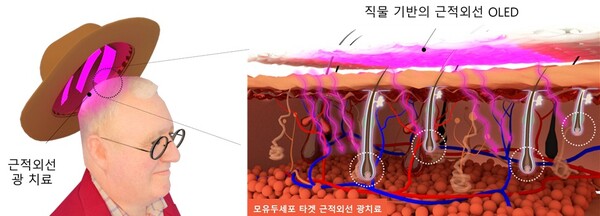
An OLED-based wearable phototherapy device for hair loss that can be worn like a cap has been developed.
KAIST said on Saturday that a team led by Professor Kyung-cheol Choi at its Department of Electrical Engineering, working with a team led by Professor Chi Yoon at the Hong Kong University of Science and Technology, developed a non-invasive hair-loss treatment technology by applying a special OLED light source to a cap-shaped wearable platform that is flexible like fabric. Non-invasive treatment does not involve cutting the skin or causing direct damage to the body.
Existing phototherapy devices for hair loss are made in rigid, heavy helmet-type structures, limiting use to indoor settings. They also use LED- or laser-based point light sources, which makes it difficult to achieve uniform irradiation across the entire scalp.
The team applied surface-emitting OLEDs that emit light evenly across a wide area to hair-loss treatment. It integrated near-infrared (NIR) OLEDs based on a flexible, fabric-like material into the inside of the cap. It designed the light source to fit naturally along the scalp’s contours, enabling uniform light stimulation across the scalp.
It also focused on suppressing the ageing of follicle cells, cited as a key cause of hair-loss progression. KAIST explained, "The key achievement of this study goes beyond implementing a wearable device, by precisely designing the wavelength of light that is most effective for hair-loss treatment to maximise the phototherapy effect."
The team implemented a customised OLED that selectively emits only near-infrared light in the 730 to 740 nm band, optimal for activating dermal papilla cells, key cells that regulate hair growth among follicle cells. In a cell-ageing evaluation, the team confirmed a cell-ageing suppression effect of about 92% compared with a control group under near-infrared OLED irradiation conditions.
Choi said, "OLEDs are thin and flexible, allowing them to adhere to the scalp’s curved surface, which has the advantage of delivering uniform light stimulation across the entire scalp." He added, "Through future preclinical studies, we plan to verify safety and efficacy and to confirm step by step the possibility of linking this to actual treatment."
The study, with Eun-hae Cho, a PhD at KAIST’s Department of Electrical Engineering, as first author, was published online in the international journal Nature Communications on Jan. 10.
 Jin-ho Lee
jhlee26@d-today.co.kr
Jin-ho Lee
jhlee26@d-today.co.kr