
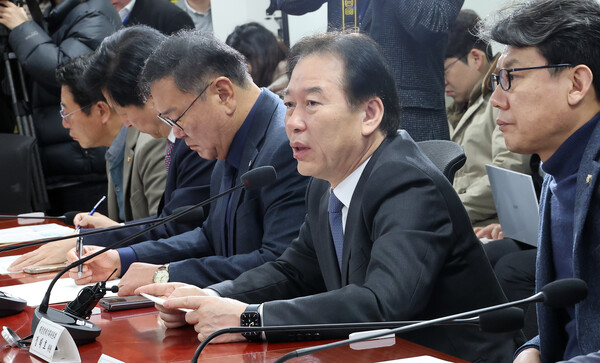
Democratic Party lawmaker Jung Tae-ho (정태호), secretary of the National Assembly's Fiscal and Economic Planning Committee, said after a party-government meeting held at the National Assembly on Thursday that the government had requested swift processing of three bills for exchange-rate stabilisation that have been submitted to parliament.
The "three bills to stabilise the exchange rate" refer to a revision to the Restriction of Special Taxation Act that Jung introduced as the lead sponsor in January.
The measures include up to a 100 percent deduction on capital gains tax when proceeds from selling overseas stocks are invested in the domestic stock market through the "Return-to-Domestic-Market Account (RIA)" system, establishing an income-deduction system for capital gains tax on FX-hedging products, and raising the non-inclusion ratio for taxable income on dividend income received from foreign subsidiaries from 95 percent to 100 percent.
Jung explained that it was called three bills because there are three main items, and the contents are contained in a single revision bill.
The bill centres on introducing an income-deduction system for capital gains tax on sales of overseas stocks and creating an income-deduction system for capital gains tax on FX-hedging products for individual investors who lack tools to manage exchange-rate risks.
It also includes provisions to temporarily cut taxes on dividend income received by domestic companies from foreign subsidiaries. The rules would temporarily raise the non-inclusion ratio, the portion excluded from tax calculations.
The party and the government view passage of the legislation as a way to resolve a structural supply-demand imbalance in the foreign exchange market and stabilise the exchange rate by encouraging overseas assets to flow back into the domestic market.
Jung said the government had announced measures and that he, as secretary, had introduced the bill, adding that the committee should begin holding a subcommittee meeting on bills from next week to review it. He added that the plenary session scheduled for March 12 would be difficult, and that around March 19 might be possible.
 Sangyeop Oh
yub@d-today.co.kr
Sangyeop Oh
yub@d-today.co.kr