
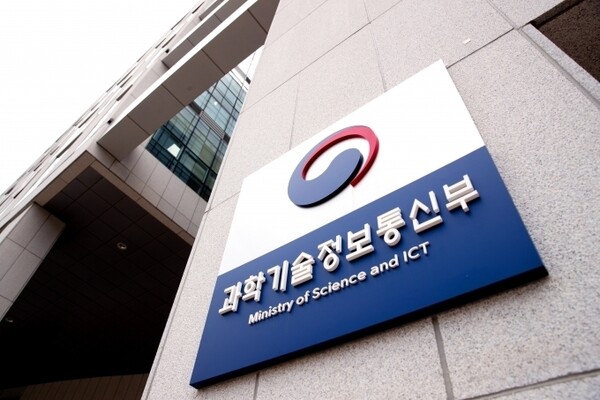
South Korea's Ministry of Science and ICT held an awards ceremony on Friday at the Four Seasons Hotel in Seoul for the "2025 list of 100 best national research and development achievements".
The 100 best national R&D achievements programme selects outstanding national R&D outcomes to raise public understanding and interest in the role of science and technology and to boost the pride of scientists and engineers. It has been in place since 2006.
The ministry received 970 recommended outcomes this year from 23 ministries and agencies that carried out national R&D projects. It made a final selection of 100 achievements in six fields after a public verification process, focusing on tasks with strong R&D results and economic and social spillover effects.
At the ceremony, Park In-kyu (박인규), head of the Office of Science and Technology Innovation, presented certificates and plaques in the deputy prime minister's name to 12 recipients chosen as top achievements, with two in each field. A commemorative photo session with all winners followed, along with remarks from recipients.
Lee Jeong-min (이정민), head of the corporate-affiliated research institute at IM Biologics, the principal investigator of a project that achieved a technology export worth 1.7 trillion won through the development of a treatment for autoimmune diseases, said, "Support from the national R&D programme allowed us to pursue challenging technology development." Lee added, "We will focus even more on R&D so that it leads to the actual launch of a new drug and helps ease the suffering of patients with autoimmune diseases."
Jeong Young-gyun (정영균), a postdoctoral researcher at the Korea Institute of Science and Technology, was selected as a social problem-solving achievement and an outstanding achievement after developing a technology to recover rare earths, a strategic resource, efficiently and in an environmentally friendly way from waste. Jeong said, "I am glad that by developing a technology to stably recover rare earths from discarded waste, we can reduce industrial waste and contribute to securing strategic resources." Jeong added, "I will continue to focus on research that helps the nation and society."
The Korea Coast Guard had a project under its jurisdiction selected for the 100 best achievements list for the first time this year. Lee Seung-hwan (이승환), head of the Pollution Control Planning Division at the Korea Coast Guard, said, "I would like to thank the researchers at the Korea Research Institute of Ships and Ocean Engineering for their efforts in developing the world's first large-scale amphibious oil recovery equipment." Lee added, "We will continue policy efforts so that the results of technology development can be used effectively in the field."
Winners of the 100 best achievements list can receive additional points in future national R&D project selection and project evaluation processes. They can also be recommended as candidates for merit awards for contributions to national R&D performance evaluation. The ministry plans from this year to 추진 a dedicated follow-up R&D programme for outstanding achievements to support improvements in technology readiness and links to commercialisation.
Park said, "Researchers' effort and perseverance are the driving force of South Korea's growth." Park added, "We will increase research efficiency through timely and targeted R&D investment and the development of science and technology AI-based models, and we will create an environment in which researchers can produce results."
 Jin-ho Lee
jhlee26@d-today.co.kr
Jin-ho Lee
jhlee26@d-today.co.kr