
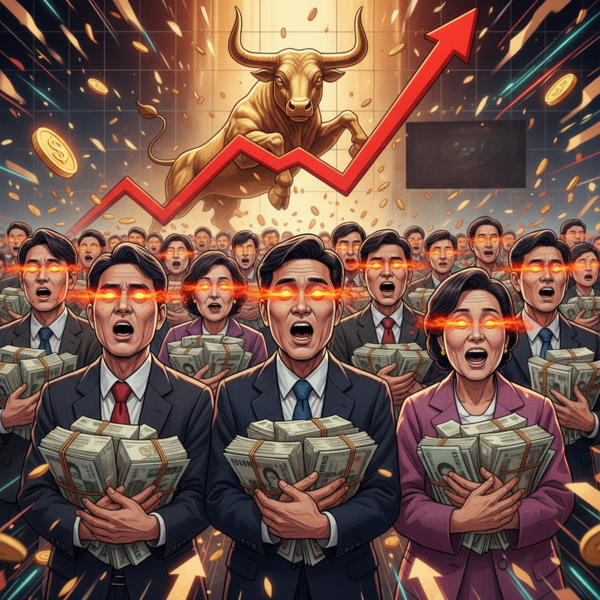
South Korea's stock market is holding an unprecedented liquidity surge as it extends a string of record highs. Foreign investor ownership and retail investor deposits have both hit all-time highs, reviving concerns about a short-term correction on signs of overheating.
The KOSPI on Jan. 29 closed up 50.44 points, or 0.98%, at 5,221.25, setting a record high. The Kosdaq also surged 30.89 points, or 2.73%, to end at 1,164.41, resetting its peak.
On the KOSPI, retail investors led the rise with net buying of 1.62 trillion won. Foreign investors and institutions took profits with net selling of 1.51 trillion won and 150.2 billion won, respectively.
An unusual flow pattern was detected in the Kosdaq. Over the four days since the Kosdaq broke above 1,000 on Jan. 26, institutional investors posted net buying of 8.62 trillion won, driving a 17% surge in the index.
But an analysis says the buying was effectively funded by retail investors. That is because 7.77 trillion won, close to 90% of institutional net buying, came from financial investment. The financial investment buying emerged as individuals bought large amounts of Kosdaq-related exchange-traded funds (ETFs).
Lee Jae-won (이재원), an analyst at Shinhan Investment Corp, said, "When individuals buy ETFs, brokerages acting as liquidity providers buy the underlying index components in the market to hedge." He said, "This creates an optical illusion in which the volume is counted as net buying by financial investment."
In other words, retail investors gripped by fear of missing out are betting on the index itself through ETFs instead of individual stocks, effectively forcing institutional flows higher.
During the same period, retail investors took profits by selling as much as 9 trillion won worth of individual Kosdaq names such as EcoPro and EcoPro BM. But the KODEX Kosdaq 150 ETF ranked first in overall net buying, with net purchases of 2.26 trillion won.
Moves by foreign investors also appear unusual. The Korea Exchange said that as of Jan. 7, foreign ownership of market capitalisation in the main stock market stood at 37.18%, the highest in 5 years and 9 months since April 2020.
The stock market boom has also loaded retail investors with record levels of dry powder. The Korea Financial Investment Association said that as of Jan. 27, investor deposits totalled 100.28 trillion won, opening the 100 trillion won era for the first time. That was an increase of more than 2.7 trillion won in a single day from 97.54 trillion won on Jan. 26.
The number of active stock trading accounts also reached 99,819,630 as of Jan. 27, nearing 100 million. Combined trading value in the KOSPI and Kosdaq markets also surpassed 46 trillion won, nearly doubling from the end of last year.
As stocks rise without pause, market outlooks are split tightly between further gains and a correction.
Kim Jong-young (김종영), an analyst at NH Investment & Securities, said, "If policy expectations for the Kosdaq market and an expansion of liquidity combine to push it into an overheated phase, the Kosdaq could have room to rise as high as 1,500 points."
As retail investors keep buying the Kosdaq 150 ETF, the assets under management (AUM) of related ETFs have also swelled to around 5.2 trillion won.
Voices warning of overheating are also growing louder. Record-high margin lending balances are being cited as a potential trigger. The Korea Financial Investment Association said that as of Jan. 27, the margin loan balance jumped to 29.25 trillion won.
Margin lending can maximise returns when stock prices rise, but in a downturn it can become a double-edged sword as forced selling due to insufficient collateral value pours out and deepens declines.
Brokerages are stepping up bull-market marketing by offering events with annual interest rates in the 3.9% range, and margin trading is expected to grow further.
A financial industry official said, "The current pace of gains is outstripping the pace of improvement in fundamentals." The official warned, "Above 5,200 on the KOSPI and 1,100 on the Kosdaq, even a small shock could unleash selling and lead to a highly volatile market."
 Oh Sang-yup
yub@d-today.co.kr
Oh Sang-yup
yub@d-today.co.kr