
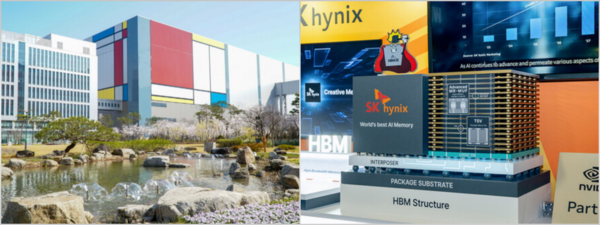
The landscape of the HBM market is set to change this year. Samsung Electronics is starting mass production and shipments of fourth-generation high bandwidth memory (HBM) products, ending SK Hynix’s run of dominance. Both companies are receiving requests from major customers for multi-year long-term supply agreements, and competition to lock in contracts in the first and second quarters is expected to determine market control over the next 2 years.
Conference calls on earnings from both companies on Jan. 29 showed that SK Hynix dominated the HBM market through the fourth quarter of last year. SK Hynix said its HBM sales more than doubled from a year earlier, posting its best-ever annual results in its DRAM business. SK Hynix CEO Song Hyun-jong (송현종) said, "As a supplier that can stably provide both HBM3E and HBM4 at the same time, we have both proven quality and mass production capability." Samsung Electronics, by contrast, saw its fourth-quarter DRAM average selling price rise 40 percent from the previous quarter, but that reflected a supply strategy focused on server DDR5 rather than HBM.
That competitive dynamic is expected to change sharply from February. Samsung Electronics will begin mass production and shipments of HBM4 volumes this month, including a top-bin 11.7 Gbps product. Kim Jae-joon (김재준), vice president of Samsung Electronics' memory business, said customer evaluations have been progressing smoothly since sample supplies last year and have now entered the call-complete stage. He said the company is receiving feedback that it has secured differentiated performance competitiveness. Samsung Electronics said it has secured purchase orders for all of its prepared HBM production capacity this year and expects HBM sales this year to more than triple from last year.
Head-to-head competition between the two is spreading into a battle to secure long-term supply agreements. Song said customers want LTA terms not as single-year agreements but as multi-year contracts, and that, unlike in the past, strong mutual commitment between customers and suppliers will be reflected. Kim said major customers want to finalise supply talks early even for volumes for 2027 and beyond, adding that requests for long-term supply agreements are also being received from large customers.
For now, market conditions favour suppliers. Song said demand is surging as AI infrastructure investment expands, but the industry’s supply capacity is not keeping pace, leading to an extreme supply-demand imbalance. SK Hynix said its fourth-quarter DRAM inventory level fell from the previous quarter and expects inventories to keep dropping further from current levels as the second half of this year approaches. Samsung Electronics also said major customers’ HBM demand this year exceeds its supply scale.
◆ Customers want early confirmation of 2 to 3 years of volumes; battle to secure long-term supply deals
The industry sees long-term supply agreements signed in the first and second quarters as effectively determining the market landscape through 2027. Given the characteristics of the HBM market, once a company secures primary supplier status it tends to become entrenched through product validation and system optimisation. An industry official said major customers including Nvidia want to lock in 2 to 3 years of volumes in advance not only to ensure stable supply, but also to closely link next-generation GPU roadmaps with memory supply.
There are broadly 2 scenarios. One is that SK Hynix maintains primary supplier status based on its existing advantage. In that scenario, the "mass production experience and quality trust built since the HBM2E era" that Song has highlighted acts as a decisive variable. SK Hynix supplied HBM4 samples first in the world in March last year and built a mass production system in September. It has an advantage in supply stability, particularly because it is "currently mass producing the volumes requested by customers." In that case, Samsung Electronics may be limited to securing only some volumes as a secondary supplier.
If Samsung Electronics rebounds on the back of technological competitiveness, it could quickly recover lost share. Kim said the company will continue to maintain technology leadership based on the stability of its 1c-nanometre process. Samsung Electronics has already secured 16-layer stack technology and hybrid copper bonding (HCB), a next-generation stacking technology. It delivered HBM4-based HCB samples to major customers last quarter and began technical discussions, and it plans some commercialisation at the HBM4E stage. As Samsung Electronics CFO Park Soon-cheol (박순철) said customers are assessing that Samsung is back, there is analysis that performance competitiveness alone could leave room to secure part of primary supplier status.
It also needs to be considered that supply strategies may vary by customer. Both companies are moving to reduce reliance on a single customer. SK Hynix said it is aiming for an "overwhelming market share" in HBM4 as well, but it also said it will seek directions that can improve short- and long-term operational stability for customers and the company, suggesting a multi-customer strategy. Samsung Electronics said it plans to differentiate by focusing on the high-end market even within an HBM market where supply shortages are expected, signalling a selective supply strategy. That suggests the two companies could divide roles depending on the custom HBM specifications each customer demands.
The key is competition in HBM4E and custom HBM. With both companies actively discussing custom HBM technology with major customers, long-term contracts in the first and second quarters are likely to include not only HBM4 but also next-generation product roadmaps. Song said, "We are actively conducting custom HBM technology discussions with major customers," stressing preparation for next-generation products. He said the market after HBM4 will see custom HBM, combining fine processes for the base die with system optimisation, emerge as a key competitive element beyond simple stacking competition. Kim also said the company plans in the second half to run pre-wafer inputs in parallel by task, in line with customer schedules, for custom HBM products based on HBM4E core dies.
 Seok Dae-geon
d2dg@d-today.co.kr
Seok Dae-geon
d2dg@d-today.co.kr