
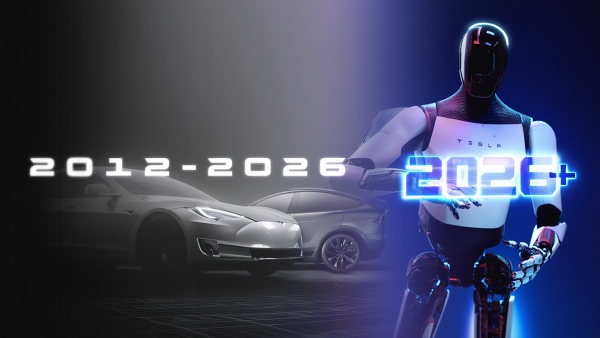
[DigitalToday reporter Hyunwoo Choo] Elon Musk (일론 머스크) has argued that Tesla is not a car company. The latest earnings release shows Tesla now appears to be focusing on AI and robots more than cars.
Musk recently told investors Tesla will stop producing the Model S and X and instead build the humanoid robot Optimus. Tesla is also investing $2 billion in xAI and is considering cooperation with Musk's AI startup.
Business Insider reported on Jan. 29 that Tesla beat Wall Street expectations but posted its first annual revenue decline and a 46 percent drop in profit. Its 2025 annual revenue fell 3 percent from a year earlier to $94.8 billion, its first decline since the company was founded. Fourth-quarter revenue also fell 3 percent but slightly topped Wall Street expectations of $24.79 billion.
Automotive revenue fell 11 percent from a year earlier, but Musk appeared unfazed by scaling back the car business, saying AI and autonomous driving will be central to the future. Tesla shares rose about 3 percent in after-hours trading after the results.
More worrying than the results is rising costs. Fourth-quarter vehicle revenue fell 11 percent and deliveries dropped 16 percent, but operating expenses jumped 39 percent over the same period. Operating profit fell 11 percent and net profit plunged 61 percent. Net profit fell to $840 million in the fourth quarter of 2025 from $2.13 billion in the fourth quarter of 2024.
This trend could weigh on Tesla's long-term growth. With falling revenue and rising costs, Tesla's profitability is deteriorating, and this is likely to increase pressure on future investment strategy and production cost optimisation. Cleantechnica pointed out, "Tesla's problem is not simply a drop in revenue but a worsening cost structure."
External conditions are also changing quickly. The U.S. market slowed sharply after a $7,500 tax credit ended, and Ford and GM recorded losses of billions of dollars after cancelling EV models. In China, local companies such as BYD are dominating the market and eating into Tesla's market share.
Tesla's makeover...from cars to AI and robots
Tesla has recently changed its Autopilot and FSD (Full Self-Driving) policies, reinforcing its image as a technology company. It is shifting FSD, previously sold for $8,000, to a subscription model, removing basic Autopilot and flagging a price increase. This appears to be a strategy to generate revenue from software and subscription services rather than car sales. Musk stressed that FSD is essential to Tesla's future and set a goal of 10,000,000 FSD subscriptions by 2035.
The AI-driven shift is even more evident in its robotaxi and Optimus robot projects. Tesla launched a robotaxi service in Austin in June last year and plans to operate robotaxis in half of the United States by the end of this year. RBC Capital Markets analyst Tom Narayan said 75 percent of Tesla's long-term value would come from robots and autonomous driving.
 Hyunwoo Choo
cookinpapa@d-today.co.kr
Hyunwoo Choo
cookinpapa@d-today.co.kr