
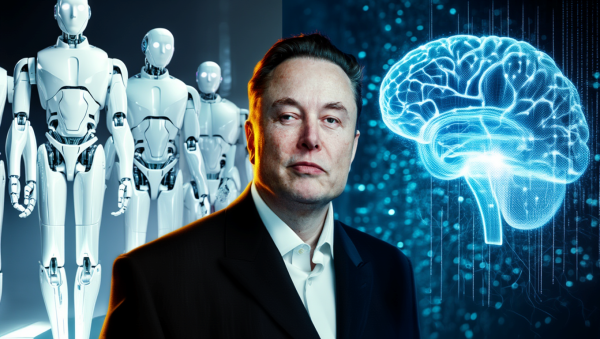
[DigitalToday reporter Yoonseo Lee] Elon Musk (일론 머스크), Tesla's chief executive, declared that Tesla would develop artificial general intelligence, or AGI. But the market is split because his past claims of AI innovation have repeatedly missed the mark.
On March 4 local time, electric-vehicle outlet Electrek reported that Musk claimed in 2023 that Tesla had "implemented some of AGI" and predicted in 2024 that AGI would arrive by 2025. AGI did not appear even after 2025 passed, and he again referred to 2026 as "the year of the singularity".
Musk's AI timeline has repeatedly followed a pattern of "prediction, missed deadline, resetting the target date". His latest AGI declaration, like past remarks, lacks a clear definition or verification standards, prompting mixed market reactions over how much weight to give it.
This time he argues Tesla will realise AGI through its Optimus humanoid robot, but this only repeats the pattern of past self-driving predictions that failed to materialise. Tesla has stressed since 2016 that its vehicles had the hardware needed for full self-driving, or FSD. From 2019 to 2025 it repeatedly projected that it could be achieved by year-end each year. The feature did not become reality as planned, and robotaxi operations in Austin were also said to be limited to about 30 vehicles, with most not operating at all times and in-car safety staff still required.
Scheduling confusion has also recurred in its hardware roadmap. In November 2025, Musk highlighted an eighth-generation AI chip, but criticism followed that self-driving targets promised for earlier-generation chips remained unresolved. In January 2026, he said the AI5 chip design was "almost finished", but the timing also conflicted with a previous remark that it was "completed", reviving debate over credibility.
Musk is presenting AGI development as a core value for Tesla, but criticism has also emerged that his AI company xAI is siphoning off Tesla resources. Tesla investors filed a lawsuit, arguing Musk is using Tesla resources to grow xAI. xAI has now announced plans to develop AI for Tesla robots, creating the appearance that Tesla's AI strategy is moving outside the company.
His AGI declaration appears to be an attempt to package Tesla as an AI innovation company. However, AI experts are sceptical about the feasibility of AGI, and amid Tesla's falling revenue and intensifying competition, they assess Musk's remarks as closer to a publicity strategy than reality.
Tesla's core business, meanwhile, is declining. Tesla delivered 1.63 million vehicles in 2025, down 9 percent from a year earlier, and revenue fell 3 percent to $94.8 billion, marking its first-ever revenue decline. Rival Chinese electric-vehicle maker BYD sold 2.26 million electric vehicles in 2025, overtaking Tesla. Tesla's market share is also plunging in Europe and China.
Even so, Tesla's corporate value still carries a high premium. That suggests it relies heavily on a narrative that values it as an AI and robotics company rather than an automaker, and it is also the backdrop to interpretations that Musk's AGI comments are tied to strengthening an "AI story".
Tesla will be one of the companies to make AGI and probably the first to make it in humanoid/atom-shaping form
 Yoonseo Lee
yslee@d-today.co.kr
Yoonseo Lee
yslee@d-today.co.kr