
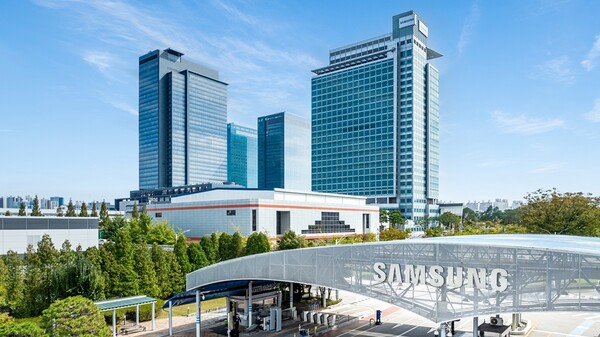
Samsung Electronics posted record results in the fourth quarter of 2025. Memory led the growth, while other business divisions were relatively weak.
Samsung Electronics posted fourth-quarter revenue of 93.8 trillion won and operating profit of 20.1 trillion won. Operating profit from its Device Solutions (DS) semiconductor division was 16.4 trillion won, or 82 percent of the total. Memory drove overall performance, while non-memory businesses such as foundry and System LSI, and the mobile and home appliance businesses, were weak.
In an earnings conference call on Jan. 29, Samsung Electronics said full-year 2025 revenue was 333.61 trillion won and operating profit was 43.6 trillion won, up 11 percent and 33 percent from a year earlier. Operating profit in the DS division rose to 24.9 trillion won, up by nearly 10 trillion won. Other divisions, including foundry and System LSI, still faced difficulty improving profitability.
The foundry business stayed in the red despite higher revenue. Kang Seok-chae (강석채), a foundry business vice president, said the company ramped up mass production of first-generation 2-nanometer products in the fourth quarter and began shipping 4-nanometer HBM base-die products. Demand from U.S. and Chinese customers lifted revenue from the previous quarter, but provisions-related costs limited profit and loss improvement, he said.
System LSI also faced continued challenges. Shin Seung-cheol (신승철), a System LSI business vice president, said quarterly results fell due to seasonal demand changes at major customers and adjustments to new product supply schedules. He added that image sensor revenue grew on expanded sales of 200-megapixel and Big Pixel 50-megapixel new products.
The Device eXperience (DX) division, including the mobile business, also lagged semiconductors. Fourth-quarter revenue was 44.3 trillion won, but operating profit was 1.3 trillion won. Revenue fell 8 percent from the previous quarter, and operating profit dropped by more than 2 trillion won. Cho Seong-hyeok (조성혁), a Mobile eXperience (MX) business vice president, said revenue and profit fell from the previous quarter as flagship smartphone sales declined due to a weaker impact from new model launches.
The Visual Display (VD) business, which oversees home appliances including TVs, posted a fourth-quarter loss. Lee Heon (이헌), a VD business vice president, said results in home appliances fell due to a continued seasonal off-peak period and the impact of global tariffs. VD revenue rose from the previous quarter due to year-end seasonality, but profitability deteriorated amid intensified competition and responses to low-price strategies.
FOUNDRY ORDER GAINS VS PROFITABILITY IMPROVEMENT TASK
Samsung Electronics' foundry business has been slow to improve results despite securing technological competitiveness. Kang said the company is focusing on stabilising its 2-nanometer process while work continues on timely development of follow-on processes. He stressed that it has also continued to strengthen advanced packaging competitiveness, including building leading-edge process 3D hybrid copper bonding technology.
On the 2026 outlook, Kang said the company expects revenue to grow by more than double digits from a year earlier, centred on leading-edge processes, and expects results to keep improving. He said mass production of new products applying a second-generation 2-nanometer process will begin from the second half. He added that the U.S. Taylor fab is also being built to start operations on schedule this year.
Order gains are also becoming visible. Kang said it is actively discussing tasks with large U.S. and Chinese customers after winning an order from Tesla. He said the company expects to secure 2-nanometer orders for HPC and AI applications by more than 130 percent from a year earlier.
He also stressed one-stop solution competitiveness. Kang said the company is developing and working on mass production cooperation for various HBM products as part of a one-stop solution that 3D-stacks a base die made with a logic process and a core die made with a memory process. He said tangible results from a turnkey business model are also expected over the mid to long term.
CFO Soon-cheol Park (박순철) said the memory business will regain a clear lead in technological competitiveness, and the foundry business will turn various order expansion opportunities gained through improving process completeness into results. He said System LSI will deliver overall transformation by securing business competitiveness.
SAMSUNG ELECTRONICS' 'PORTFOLIO IMBALANCE' AMID THE MEMORY BOOM
For the mobile business, higher costs due to a steep rise in memory prices in 2026 is a burden factor.
Cho said shortages and sharp price increases for memory used in mobile products began to become a reality from the fourth quarter of 2025 as memory demand for AI servers expanded. He said 2026 is expected to be a difficult business environment, but it is an issue across the industry.
As a response strategy, he presented stabilising and streamlining the supply chain. Cho said the company will respond proactively and flexibly to changes in the market and competitive environment based on stable component procurement through strategic partnerships with key partners. He said it plans to minimise the risk of profit declines through strategic responses, including resource efficiency activities across the entire process.
He also said the company is focusing on strengthening product competitiveness. Cho said it will drive revenue growth through a successful S26 launch in the first quarter, sustained solid sales of foldable products that are showing strong sales, and expanded sales of M-1 and FE product lines.
The display business is also within the impact range of rising memory prices. Heo Cheol (허철), a Samsung Display vice president, said 2026 will be a tougher year than any past year due to demand uncertainty in the smartphone market and pressure on panel selling prices stemming from memory market price increases. He said the company will push to secure extreme cost competitiveness, including improving productivity.
The TV business is seeking a breakthrough through a service business. Lee said the company will secure growth engines with next-generation devices and further expand its service business. He stressed that it will further advance Samsung TV Plus and the Art Store and strengthen partnerships with various content companies to differentiate content and also work to increase TV revenue.
Park said various risks, including global tariff barriers and geopolitical uncertainty, are expected to persist in 2026, but the company will work to prepare one step ahead and respond proactively to such external changes. He said it will secure fundamental competitiveness through overwhelming product technology, proactive supply chain diversification and operational optimisation, and will aim to maintain business competitive advantages despite rising component prices and tariff risks.
 Dae-geon Seok
d2dg@d-today.co.kr
Dae-geon Seok
d2dg@d-today.co.kr