
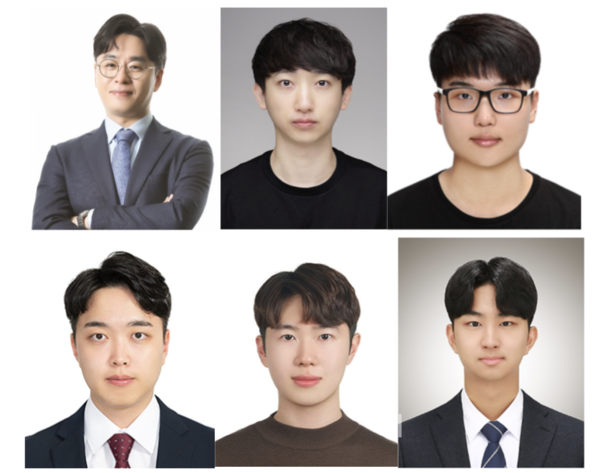
A research team led by Professor Sanghoon Jeon of KAIST’s School of Electrical Engineering presented an AI semiconductor technology that integrates sensing, computing and memory into one. KAIST said on Wednesday the team presented six papers at the International Electron Devices Meeting (IEEE IEDM 2025) held in San Francisco from Dec. 8 to 10. IEDM is the world’s most prestigious semiconductor conference.
The team’s presentation was selected simultaneously as a highlight paper and a best student paper. The highlight paper, an M3D (Monolithic 3D) integrated neuromorphic vision sensor, stacked a light-sensing sensor and signal-processing circuits vertically and placed them on one chip. The structure enables sensing and decision-making to happen at the same time.
The team completed what it called the world’s first in-sensor spiking convolution platform, in which AI computation takes place inside a camera sensor while it sees and judges at the same time. Previously, it required multiple steps, including capturing an image, converting it into numerical data, storing it in memory and computing again.
The technology enables computation to take place directly inside the sensor, eliminating unnecessary data movement. It makes possible real-time, ultra-low-power edge AI by reducing power consumption and increasing response speed.
The team presented six technologies spanning all layers of an AI chip from input to storage. In sensors, it designed the system so judgment happens at the sensing stage without separating image-capturing and computing components. It said the approach reduces power consumption and speeds up response compared with the conventional method of sending captured images to another chip for computation.
In memory, it implemented next-generation NAND flash that operates at low voltage, can be used for a long time and stably stores data even when power is off. The study selected as the best student paper is a ferroelectric NAND cell applying an IGZO (Indium Gallium Zinc Oxide) charge-trapping layer.
IGZO is an oxide-based semiconductor channel material with strong low-power characteristics. The team proposed a highly thermally stable oxide channel and thin-film designs that reduce voltage, improving stability and durability in large-scale data storage. It stressed it presented foundational technology that meets the need for high-capacity, high-reliability, low-power memory required for AI.
The team said combining these technologies could enable expansion into a next-generation AI hardware platform in which sensing, computing and memory operate organically in areas such as ultra-low-power edge AI, autonomous driving, robots and smart devices.
Sanghoon Jeon said, "We demonstrated that it is possible to move away from the conventional AI chip architecture, where sensing, computing and storage are designed separately, and integrate all layers into a single material and process system." He added, "We will expand it into a next-generation AI semiconductor platform spanning ultra-low-power edge AI to large-scale AI memory."
The research was supported through the Ministry of Science and ICT and the National Research Foundation of Korea’s Basic Research Program, as well as the CH³IPS (Center for Semiconductor Technology Research for Overcoming Limits of Heterogeneous Integration at Extreme Scale and Extreme Properties). It was conducted in collaboration with Samsung Electronics, Kyungpook National University and Hanyang University.
 Daegeon Seok
d2dg@d-today.co.kr
Daegeon Seok
d2dg@d-today.co.kr