
As the use of artificial intelligence and big data becomes more important, the value of data is rising more than ever. At the same time, as personal information protection regulations tighten, companies and institutions are feeling pressure to choose between “innovation” and “security.”
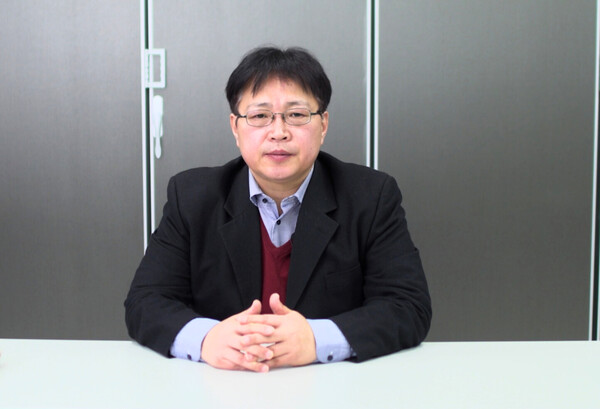
A company is drawing attention for presenting a way to make protection and use compatible, rather than treating them as an either-or choice. That company is Jeongu Maru, which specialises in privacy-protecting synthetic data generation solutions and is led by CEO Choi Eui-soon (최의순).
Jeongu Maru was recently selected for the Ministry of SMEs and Startups' Tech Incubator Program for Startups, or TIPS, and its technology was recognised. It also secured seed funding and was rated an outstanding company in the “2025 Startup-Centered University” programme supported by the ministry and the Korea Entrepreneurship Foundation and hosted by Hanyang University.
Choi said Jeongu Maru was founded to solve two conflicting issues at the same time: personal information protection and data use. He explained that the company is developing technology that safely reproduces only the real-world structure needed for decision-making without using actual personal information.
‘Designing real-world structure’ redefines synthetic data
A core concept running through Jeongu Maru’s business is “Reality Structure Engineering.” Jeongu Maru does not view synthetic data as simply “creating fake data,” and it approaches the task not by copying reality but by designing the structure by which reality works.
In environments such as finance and public institutions, where personal information cannot be taken outside, companies and institutions had no choice but to give up AI training and data analysis. To solve this problem, Jeongu Maru chose an approach that designs the structure of how reality operates so that business rules, relationships and context are not broken, rather than producing data that merely has similar values.
Choi said that while existing synthetic data focused on how similar it is to real data, Jeongu Maru places greater importance on whether decisions can actually be made using the data. He stressed that Jeongu Maru is not so much a company that makes synthetic data as a company that enables safe decision-making through data.
Three core capabilities underpinning the synthetic data solution RealDataEcho
Jeongu Maru’s core capabilities can be summarised in three areas. The first is its privacy-protecting synthetic data solution RealDataEcho. It generates data that AI can use for learning and analysis without using any actual personal information. In particular, it designed the basic structure as an on-premises model that can be operated inside a client institution, reflecting environments such as finance and public institutions where taking data outside is difficult.
The second is “synthetic data quality verification and explainability.” Jeongu Maru does not present data that simply “looks similar,” but clearly explains in figures and reports how similar the data is to reality and what decisions it can be used for. This provides a structure that can be used for internal audits and responses to regulators.
The third is “data generation technology that reflects domain structures.” It preserves business rules, hierarchical structures and semantic relationships between data, rather than relying on simple statistical replication. Recently, it has applied ontology-based design and is expanding its technology to synthetic data that reproduces not the values of data but the structure and context of reality together.
Choi said ontology-based design is the biggest difference from existing synthetic data. He explained that preserving meaning, relationships and structure together can create an environment in which AI can explain not only its predictions but also why it made such judgments.
Not “similar data,” but “data you can make judgments with”
Choi pointed to Jeongu Maru’s strength not as the sophistication of synthetic data technology itself, but as redefining it as “decision-making infrastructure.” He said the goal is to secure both usability and reliability of synthetic data at the same time.
He said there are many companies with synthetic data technology, but few move as far as creating data that can be used for real decision-making. He explained that Jeongu Maru is focusing on producing not data that looks similar but “data you can make judgments with.”
From finance and public sectors to medical and healthcare, expanding the realm of trust
Jeongu Maru’s mid- to long-term vision is clear. Choi said it is to ensure that important decisions in society and industry do not stop even without using real data. To that end, Jeongu Maru is currently driving its business mainly in finance and the public sector, but it plans to expand into medical, healthcare and global markets. It is focusing in particular on expanding into areas where data is sensitive but decisions are essential.
Technically, it is implementing an explainable AI environment by combining synthetic data with ontology, large language models and retrieval-augmented generation. Choi said that in the long term Jeongu Maru wants synthetic data to be established not as a single solution but as basic infrastructure that enables trustworthy decision-making. He added that the company aims to create technology and standards that can be used for a long time rather than growing quickly.
 Byunghee Lee
shake@d-today.co.kr
Byunghee Lee
shake@d-today.co.kr