
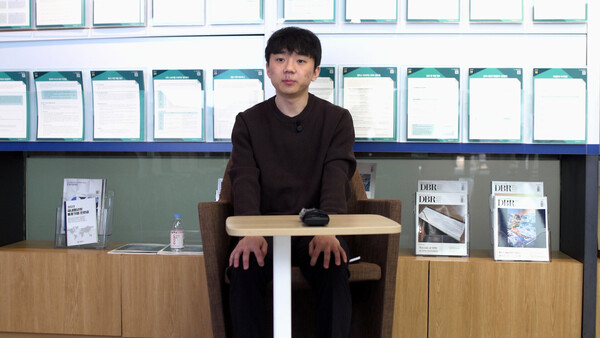
[DigitalToday guest reporter Lee Byeong-hee] As companies accelerate the adoption of artificial intelligence (AI), security discussions are also heating up. But most debate focuses on the safety of the model itself. Security in the execution process, where AI agents actually call internal corporate tools and access sensitive data, remains a blind spot.
A company has emerged to fill that gap. Aware Corporation, led by CEO Kim Do-hyeon (김도현), is a startup pioneering the area of "runtime security" between AI agents and corporate infrastructure.
AI runtime security refers to a security approach that detects and blocks, in real time, threats that occur during actual operations of AI applications, models and data, such as prompt injection, data leaks and model manipulation.
Kim said the most urgent security problem companies face arises when agents they build and operate access sensitive data. He said the key is to ensure proper permission controls and audit trails when agents access corporate sensitive data.
◆ A blind spot in existing security systems: the agent execution phase
Current corporate AI security discussions focus only on the model itself, such as whether responses are safe and whether prompt injection is possible. But the real risk lies elsewhere. For agents to be used meaningfully, it is inevitable that they will access sensitive information such as customer databases and corporate human resources information.
Visibility must be secured on who can access, who actually accessed and when, and what data left the system, Kim pointed out. He said this is not standardised at present.
For example, existing security frameworks are designed to distinguish access permissions for HR information by levels such as regular employees and executives. But agents can bypass that permission system itself. That means a regular employee could access an executive's salary information through an agent.
Kim said there is a serious mismatch between existing security systems and new problems created by the adoption of AI agents. He explained that Aware Corporation focused on solving that mismatch.
◆ Runtime security, a new standard area
The solution Aware Corporation offers is to secure security during the execution process (runtime) in which AI agents interact with corporate infrastructure. Its main functions can be summarised in three.
The first is access control. It clarifies which data sources an agent accesses, what exactly its access permissions are, and which user accesses that data and at what time.
The second is an audit log. It records and tracks whether a user has a legitimate reason to access data and what data actually moved. It becomes decisive evidence later for compliance verification or security incident analysis.
The third is a security audit report. It makes it possible to see at a glance what corporate data sources the agent is connected to and when interactions occur between them and how frequently.
Kim stressed that for AI to be used at the enterprise level, a single foundation model is not enough. He said companies can use AI meaningfully only when permission systems are properly in place, security is made visible and problem-solving is carried out systematically.
◆ Clear differentiation from existing solutions
Aware Corporation's differentiation strategy is drawing attention. While various overseas security solutions remain at a "guardrail" approach that monitors only prompts and model responses, Aware Corporation looks one level below that.
Existing solutions monitor only at the model and prompt level. But no one is currently able to track how agents actually interact with corporate infrastructure, or what communication occurs at the protocol level such as Model Context Protocol (MCP), Kim pointed out.
He explained that the company designed its user interface (UI) to be integrated together into applications customers actually use, so that this interaction layer can be directly observed and protected. As a result, it becomes possible to detect abnormal behaviour and respond to threats beyond simple prompt monitoring.
The reason Aware Corporation's solution is drawing attention is also linked to Kim's background. Kim entered hacking in middle school, built up experience winning major hacking competitions, and even served as a new business division leader at Theori, described as the "world's best offensive security company", making him a top talent in security.
External assessments are also positive. Aware Corporation was recently selected for the 2025 Startup-Centered University Startup Club Program promoted by the Ministry of SMEs and Startups and the Korea Institute of Startup and Entrepreneurship Development and hosted by Hanyang University, and it won the top prize at Hanyang University's venture startup competition, among other results. It also operated a booth at an event in South Korea involving a visit by Anthropic's chief technology officer, expanding points of contact with industry leaders at home and abroad.
It also attracted seed investment from global investors at the same time as establishing a U.S. corporation, and is speeding up its entry into global markets by conducting proofs of concept with security teams at major South Korean portal and commerce companies and with major U.S. AI agent companies.
Kim said Aware Corporation considers itself to be in the "closest" position to customers in South Korea's security market. He said there are many meaningful companies in South Korea with AI security as a keyword, but Aware Corporation will become a company that focuses not simply on the keyword of security but on what specific problems customers are experiencing and solves them.
 Lee Byeong-hee
shake@d-today.co.kr
Lee Byeong-hee
shake@d-today.co.kr