
Automation is advancing rapidly at manufacturing sites. As labour costs rise and hiring becomes harder, the adoption of industrial robots is spreading. The key to these robots lies in the “hand”. It is the gripper, which picks up, puts down and moves products.
The gripper’s role looks simple, but the shop floor is complex. As high-mix, low-volume production becomes routine, robots must handle products of different sizes and shapes each time. Existing grippers detect objects with expensive sensors and control them with complex programming. That work must be repeated whenever an item changes. Costs rise and it takes time. In the end, small and midsize manufacturers fall behind in adopting automation.
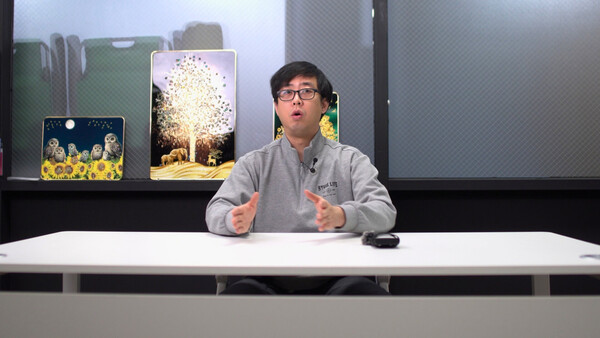
A startup that has solved this problem with software is LPtech, led by CEO Park Hyung-soon (박형순). LPtech developed a “teaching-less” gripper that can freely handle objects of various sizes and weights while eliminating expensive sensors.
Park said recognition and control are implemented with software technology instead of sensors, so there is no need for expensive sensors. He said it has drawn attention not only in South Korea but also overseas because it can sharply lower adoption costs while maintaining performance.
◆ Developing a teaching-less gripper using software technology
LPtech’s teaching-less gripper adopts a structure completely different from existing products. It breaks away from the conventional approach of detecting object size with expensive sensors and programming accordingly. LPtech developed it so that it can automatically grip objects of various sizes without sensors, using distinctive mechanical design and software technology alone.
Park said robots need to recognise that they have picked up a product, just as people use fingertip sensation when picking something up. He explained that existing grippers use very expensive sensors at the fingertips, while LPtech can handle products of different sizes and weights without costly sensors by using software technology.
As a result, it keeps high-end performance while sharply cutting adoption costs. It fully removes the cost burden of the existing approach, which required new sensor adjustment and programming for each part in a high-mix, low-volume production system.
Another of LPtech’s main products, the “anti-shake gripper”, sharply reduces residual vibration that occurs when a robot arm stops moving, enabling precision work. It effectively controls subtle vibrations in high-speed logistics transfer and precision manufacturing processes, raising productivity and lowering defect rates.
The teaching-less gripper was made possible by Park’s field experience and technical capability. Park has 10 years of experience in technical sales and 5 years as a research institute head, and through contact with various customers he learned what products were needed and where problems lay. Park said there were many difficulties with robot fingers when building smart factories. He said smart factories require a lot of capital, so the business began with robot fingers, the most difficult part. Technology born from the field became LPtech’s competitiveness.
External evaluations have also been favourable. LPtech recently won the Ministerial Award from the Ministry of Trade, Industry and Energy for its self-developed teaching-less gripper technology. It was also selected for the “2025 Startup-Centered University” programme supported by the Ministry of SMEs and Startups and the Korea Entrepreneurship Foundation and hosted by Hanyang University, and was assessed as an outstanding company.
It is popular not only domestically but also in overseas markets. In November last year, it conducted proof-of-concept (PoC) verification in 4 major European countries, including France, Germany, the Netherlands and Belgium. It received a sample PoC order worth about 50 million won from a local company in France. In the German market, it completed product exports and finished receiving payment, achieving tangible sales results.
Park said he receives many inquiry calls from overseas and is always abroad from June to November. He said he moves across a range of regions, including Europe, South America and Southeast Asia. Because Europe has the world’s highest level of robot automation, this performance is being assessed as an example proving that the technology of a South Korean research institute company meets global standards.
◆ Recognition in Europe and overseas, aiming to leap into a global robot company
Park cited “field-oriented research and development (R&D)” as LPtech’s competitiveness. LPtech operates an agile system in which the R&D team reflects feedback from field engineers in real time as it develops technology. From the early stage of development, it directly gathers field engineers’ opinions and incorporates them into technology, and quickly improves problems that arise in real-use environments.
Park said it can understand what is really needed because it develops technology while directly hearing the inconveniences of field engineers. He stressed that by leveraging the strengths of a small organisation, it can respond quickly with customisation tailored to customers’ special environments. LPtech’s major clients currently include semiconductor equipment manufacturers, secondary battery companies and logistics firms.
LPtech’s future vision is clear. It currently runs its business centred on grippers, but it plans to ultimately expand into an integrated solution that combines the three core elements of industrial robots: vision (eyes), robot arms (arms) and grippers (fingers).
Park said a robot must see with its eyes, move its arms and grip with its fingers when picking up a product. He said global companies dominate most of the robot arm market, and his next-generation vision is to combine LPtech’s gripper and vision system with global robot arms and provide them as an integrated solution.
In the short term, LPtech is pushing to expand export channels to Europe and Southeast Asia and to increase its share of South Korea’s core automation market. In the long term, it aims to become a global robot company with annual sales of 100 billion won by spreading robot technology to manufacturing sites worldwide.
 Byunghee Lee
shake@d-today.co.kr
Byunghee Lee
shake@d-today.co.kr