
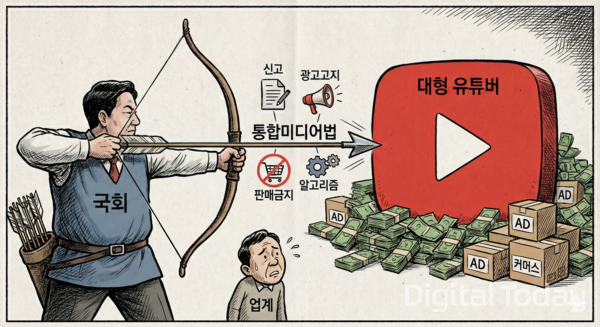
South Korea's National Assembly has unveiled a draft integrated media law to regulate large YouTube channels as audiovisual media. The aim is to impose responsibilities commensurate with their influence, but fallout is expected as it also covers regulation of commerce, a key revenue source for YouTubers.
A task force under the chair of the National Assembly's Science and ICT, Broadcasting and Communications Committee has announced a draft "Audiovisual Media Services Act" drawn up through 16 meetings over the past 7 months. The bill shifts away from the existing transmission-technology-based definition of broadcasting. It would broadly define as audiovisual media services the overall act of providing or mediating video and audio using radio waves or telecommunications facilities.
Under the draft, media services are broadly divided into a "public domain" and a "market domain". User-generated content such as YouTube is classified as an "audiovisual media content service" within the market domain, bringing it under the scope of the law.
The task force is not aiming to regulate all YouTubers. It is focusing on bringing large channels into the institutional framework that exert social and political influence comparable to legacy media while remaining in a legal blind spot.
As part of that, large YouTubers that meet certain standards such as influence and scale would be required to file notifications. The intent is to allow the government to secure a minimum level of data to understand industry conditions.
YouTubers subject to the law would also be required to disclose advertising and sponsorship. To block "backdoor ads" that fail to disclose paid promotions, the draft would impose a legal obligation to clearly inform viewers of financial support and whether content includes ads or sponsorship.
Sales inducement would also be banned. The draft considers applying broadcast-level regulation, including banning overt advertising and sales inducement for specific products, for large content producers designated by presidential decree.
The basis for regulation is the principle of same regulation for the same service. The intent is to address reverse discrimination in which legacy media face strict rules while YouTube is left alone even when both provide the same drama or news content, and to resolve the problem that accurate conditions are not understood even though YouTube earns massive revenue in South Korea. The draft reflects a consensus that, to protect users from hate speech or content that stokes conflict, some responsibility should be placed not only on platforms but also on influential individuals, or creators.
At a forum, Lee Nam-pyo (이남표), an adjunct professor at Yongin University who heads the task force, said the key standard for classification is not the scale of operators or administrative convenience but impact from the viewer's perspective. Large YouTube channels that wield influence comparable to terrestrial broadcasters while sitting in a legal blind spot should at least come within legal boundaries, he said.
Ambiguity over what counts as "large" is raising concern that it could devolve into political conflict.
But there are many contentious issues in the legislative process. The biggest challenge is setting standards for which "big YouTubers" are subject to regulation. It is unclear whether the 기준 should be subscriber counts or revenue 규모 such as advertising income or donations. In the process of setting it, issues of reverse discrimination between domestic and overseas creators could be raised.
If YouTubers with strong political influence are included, there is also a high possibility that it could become a political fight framed as press oppression or infringement of freedom of expression. The issue is known not to have been agreed even within the task force.
A task force official said some political channels are more influential than many reporting channels, and there is agreement with the idea that at least minimal data should be secured given their impact on public opinion. But the official said if this is turned into regulation it could become a political issue, risking the entire integrated media law being derailed, adding they were sceptical about the possibility.
The draft has also raised the possibility of conflict with government policies promoting the creator media industry. The Korea Communications Commission will invest 51.9 billion won out of this year's budget of 263.1 billion won in the category of building a "dynamic broadcasting, media and communications ecosystem". That includes fostering YouTube creators and related startups. The draft clause banning sales inducement could directly restrict a key source of income for them.
A content commerce industry official said commerce is a breakthrough for sustaining the creator ecosystem at a time when advertising revenue models have reached their limit. Blocking product sales that contribute to securing sales channels for local agricultural products or small businesses while leaving simple sponsorship alone makes the regulatory target unclear, the official said.
The National Assembly says the draft is only a blueprint for the bill and it will gather opinions going forward. At a forum, Roh Jong-myun (노종면), a lawmaker from the Democratic Party, said the law is not a finished blueprint but a starting point for discussion for a better structure. It is a discussion that is definitely needed, and there were worries about what to do if misunderstandings arise, but many people have worked to start the discussion meaningfully, he said.
 Seulgi Son
sageson@d-today.co.kr
Seulgi Son
sageson@d-today.co.kr