
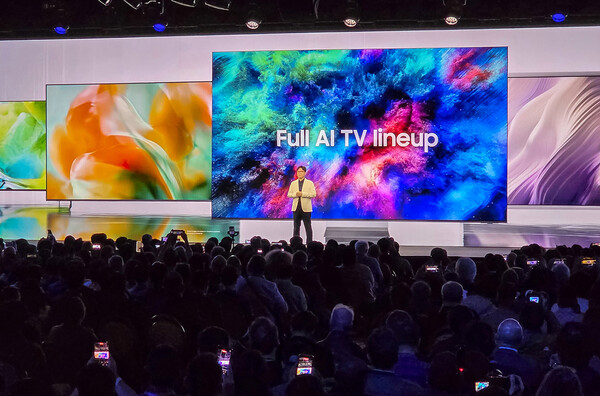
Samsung Electronics, which has kept the top spot in the global TV market for 22 years, is in focus over whether it can fend off the rapid rise of China’s TCL again this year.
Counterpoint Research data showed Samsung’s global TV shipment share in November last year was 17 percent, down 1 percentage point from 18 percent a year earlier. On a cumulative basis through November, Samsung kept a 16 percent share, but total shipments fell 0.6 percent. Over the same period, TCL increased shipments 20 percent year on year, rapidly narrowing the gap with Samsung.
Samsung has focused on targeting the premium TV market, given that Chinese companies such as TCL concentrate on mid- to low-priced products. It now faces tougher competition in that market after TCL set up a TV joint venture with Japan’s Sony.
The escalating competition is directly affecting profitability. Samsung’s VD·DA division revenue kept falling, from 14.5 trillion won in the first quarter last year to 14.1 trillion won in the second quarter and 13.9 trillion won in the third quarter. Operating profit also turned to a loss of around 100 billion won in the third quarter. The securities industry estimates Samsung likely posted a similar level of operating loss in the fourth quarter as well.
TCL’s push is stronger in emerging markets. Lim Soo-jung (임수정), a researcher at Counterpoint Research, analyzed that "TCL is winning support in price-sensitive markets such as Eastern Europe and the Middle East and Africa by offering high-resolution technologies such as miniLED at competitive prices."
TCL and Sony recently announced the establishment of a joint venture for their TV business, putting the spotlight on a possible shift in the global premium TV market landscape.
The combination of TCL, strong in mid- to low-priced TVs, and Sony, which has premium technological capabilities, is seen by many as a direct threat to Samsung. Bob O’Brien, a Counterpoint Research researcher, forecast that "Samsung is expected to keep the global No. 1 spot in 2026 as well, but Chinese brands such as TCL, Hisense and Xiaomi will step up competitive pressure in high-growth segments such as miniLED and mid- to large-sized screens."
Omdia data showed TCL and Hisense account for more than 50 percent of the global miniLED TV market. Shipments also increased to 12.6 million units in 2024 from 3.5 million in 2023.
Samsung is also moving to respond. This year it will expand its microRGB TV lineup to 7 sizes: 55-inch, 65-inch, 75-inch, 85-inch, 100-inch, 115-inch and 130-inch. It believes the smaller device size than miniLED allows differentiation in contrast and picture quality. Yong Seok-woo (용석우), president and head of Samsung’s Visual Display Business, said at a recent meeting with VD division employees that "the VD division management diagnosis is nearly complete, and the results are leading to a lineup reshuffle this year."
He also emphasized, "Within the next few years, we will raise the VD division operating profit to the 3 trillion won range." He added, "Despite the prolonged slump in the home appliance market, our response in the mid- to low-priced lineup has been insufficient," and "we will develop various strategies to strengthen the mid- to low-priced lineup."
 Dae-geon Seok
d2dg@d-today.co.kr
Dae-geon Seok
d2dg@d-today.co.kr