
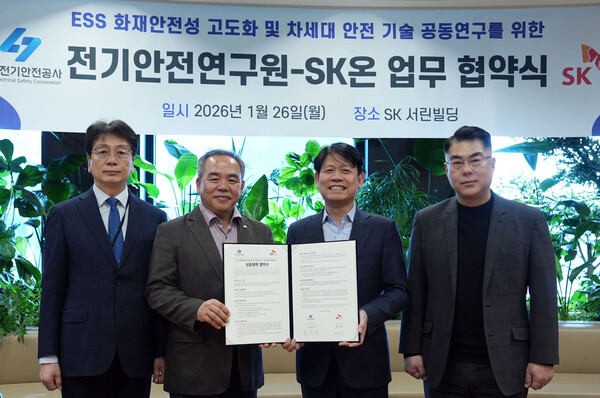
SK On is introducing a diagnostic system based on electrochemical impedance spectroscopy to strengthen the fire safety of energy storage systems. SK On said on Monday it signed a memorandum of understanding with the Electrical Safety Research Institute of the Korea Electrical Safety Corp for joint research to advance ESS fire safety and next-generation safety technology.
With the ESS market expanding, fire safety technology has emerged as a key to business competitiveness. Under the agreement, the two sides will cooperate on advancing ESS fire safety research and evaluation methods, joint research on new battery materials, and building international cooperation centred on G-SAFE.
SK On will use the infrastructure of the Energy Storage Research Center at the Electrical Safety Research Institute. It plans to raise the level of verification for next-generation safety technologies such as an electrochemical impedance spectroscopy-based diagnostic system and immersion cooling. Electrochemical impedance spectroscopy sends alternating current signals of various frequencies to a battery to identify internal resistance and reaction characteristics. It diagnoses battery performance. While conventional battery management systems monitor only the temperature of some cells, electrochemical impedance spectroscopy diagnostics can detect internal changes across all battery cells.
The Energy Storage Research Center, completed late last year in Wanju, North Jeolla Province, can verify ESS performance and safety under extreme environmental conditions ranging from minus 40 degrees Celsius to 80 degrees Celsius. The two sides will also pursue joint research to develop new materials, including improving the performance of existing lithium iron phosphate. They have continued exchanges across ESS and battery safety technology, including an SK On tour of its Daejeon Future Technology Institute during the first G-SAFE event hosted by the Electrical Safety Research Institute last year.
SK On's ESS batteries have preventive measures and post-incident measures. It applied an electrochemical impedance spectroscopy-based diagnostic technology that detects warning signs early, an industry first. It can detect fire risk at least 30 minutes in advance, and separate and replace only modules showing warning signs like blocks.
For post-incident measures, it applied a heat-blocking barrier, a heat-diffusion prevention solution using cooling plates, an explosion-prevention solution with a dual safety mechanism combining a ventilation system and blast-pressure panels, and an immersion system in which coolant is injected directly into a module.
SK On plans to secure South Korea's largest ESS battery production line, with annual capacity of about 3 GWh, through a line conversion at its Seosan plant in South Chungcheong Province this year. It will localise key materials used in ESS lithium iron phosphate batteries, including cathode materials, separators and electrolytes. It also plans to take the lead in building South Korea's lithium iron phosphate battery supply chain ecosystem.
Song Gil-mok (송길목), head of the Electrical Safety Research Institute, said: "Through technology cooperation that covers safety evaluation in the ESS field and responses to international standards, we will take the lead in restoring the domestic ESS industrial ecosystem and leading global technology."
Park Ki-soo (박기수), head of SK On's Future Technology Institute, said: "The core of ESS competitiveness is safety and technology." He added: "While advancing next-generation safety technology, we will also expand cooperation with the domestic ESS ecosystem spanning infrastructure, materials and components to contribute to the growth of the battery industry."
 Seok Dae-geon
d2dg@d-today.co.kr
Seok Dae-geon
d2dg@d-today.co.kr