
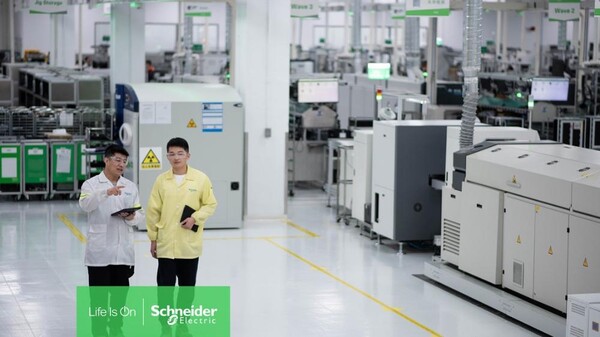
Schneider Electric said on Jan. 27 that its Wuhan plant in China has been selected by the World Economic Forum (WEF) as a talent-innovation lighthouse factory. The talent-innovation category is a new field introduced this year, with only 3 sites selected worldwide. Schneider Electric said the selection brings its total to 9 lighthouse factories, including 5 sustainability lighthouse sites.
The World Economic Forum created the Global Lighthouse Network with McKinsey & Company in 2018. The network consists of 189 production facilities and value chains worldwide that deliver results in productivity, supply chain resilience, customer centricity, sustainability and talent innovation by using Fourth Industrial Revolution technologies.
The talent-innovation category selects companies that have built an innovative workforce management system through advanced systems in job design and safety, workforce planning, recruitment and onboarding, development and efficiency.
Schneider Electric built a workforce model at the Wuhan plant that combines technology, partnerships and continuous learning to address workforce issues. It said the effort was driven by labour shortages resulting from rapid automation and an expansion of the product portfolio. It partnered with 11 vocational schools to offer a digital apprenticeship programme, an AI lab and scholarships, creating a forward-looking pipeline of skilled workers.
It also introduced an AI-based capability management system. Agent AI identifies and tracks skills gaps and assigns personalised training. The plant also runs a reward system based on skill levels. Schneider Electric said workforce capability levels improved to 76 percent from 20 percent. It added that a maintenance system using generative AI reduced repair times, while technician turnover fell to 6 percent from 48 percent.
It increased work efficiency through AI-technology-based automation and work optimisation. By automating repetitive tasks, it supported engineers in focusing on high value-added work. The new product launch cycle was shortened by 66 percent. Lead time for new product launches was reduced to 12 months from 36 months.
Murad Tamoud (무라드 타무드), Schneider Electric's chief supply chain officer, said, "Through this China Wuhan plant case, we proved that when AI and human potential create synergy together, companies can build a more resilient and future-oriented workforce." He added, "We will continue to work to provide more value to customers through the active use of advanced technologies."
 Daegeon Seok
d2dg@d-today.co.kr
Daegeon Seok
d2dg@d-today.co.kr