
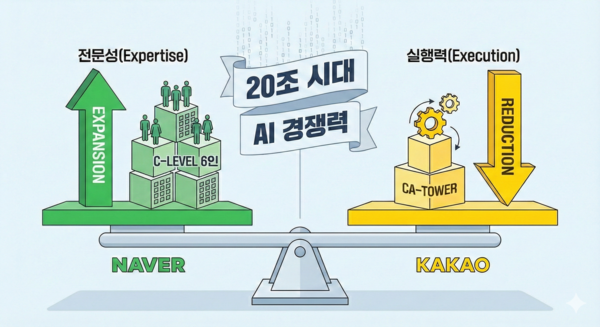
South Korea’s two biggest platform companies, Naver and Kakao, have carried out opposite reorganisations at the start of 2026. Naver chose expansion by doubling leadership, while Kakao opted for downsizing by halving its control tower.
Naver shifts to six-member C-level structure, strengthens expertise in line with business expansion
According to the industry on Jan. 27, Naver will carry out its biggest leadership overhaul since its founding. From Feb. 1 it will newly appoint Kim Kwang-hyun (김광현) as chief data and content officer, Yoo Bong-seok (유봉석) as chief responsible officer, and Hwang Soon-bae (황순배) as chief human resources officer. That will expand its C-level team to six from three.
The stated reason is integration of capabilities across “Team Naver”, but behind it is a change in the company’s scale. Naver topped 12 trillion won in revenue last year as its businesses expanded rapidly into shopping, finance, cloud and AI. The overhaul is seen as placing leaders with expertise in each field to speed up decision-making and respond quickly to change.
In particular, creating the CDO role is significant. It means combining the search and content organisations to centrally manage key AI resources. The aim is to reduce inefficiencies caused by dispersed technology and business organisations and to speed up commercialisation of AI agents.
Kakao slims CA Council, shifts to “speed management” with 147 to 94
Kakao, meanwhile, has moved to shrink its group control tower, the CA Council. It is reorganising its previously sprawling structure of “four committees, two general divisions and one unit” into “three offices (investment, finance and human resources) and four areas in charge” to clarify accountability, while cutting staffing to about half.
Behind the slimming effort is what it describes as successful restructuring. Over the past two years, Kakao carried out high-intensity restructuring amid criticism of octopus-like expansion. As a result, it cut the number of affiliates to 94 from 147.
With affiliates down about 36 percent and restructuring entering its final stage, it appears there is no longer a need for the bloated management organisation of an emergency-management period.
Rather, by reducing the authority of the CA Council, which has faced criticism as “a roof on top of a roof”, it appears to be seeking a return to a field-focused system in which affiliates can make immediate decisions on the ground. The centre will handle strategy such as investment and finance, while each affiliate takes responsibility for its actual business.
"Expansion amid stability" vs "efficiency after renewal" - the goal is ultimately "AI competitiveness"
The two companies’ divergent moves reflect differences in their current business environments. Naver has a stable financial structure and business portfolio, but chose to bolster its organisation to create a new breakthrough in the AI era. Kakao, which has faced legal risks and various controversies, adopted a strategy of trimming organisational fat and becoming leaner to move quickly.
In the end, while their approaches differ, both companies align in raising organisational efficiency toward the goal of securing competitiveness in the AI era.
An industry official said the overhaul appeared to be the best choice each company could make given its situation. The official added that a key point to watch this year is which works more efficiently in a rapidly changing market environment: Naver’s “expertise” or Kakao’s “flexibility”.
 Lee Ho-jung
lhj@d-today.co.kr
Lee Ho-jung
lhj@d-today.co.kr