
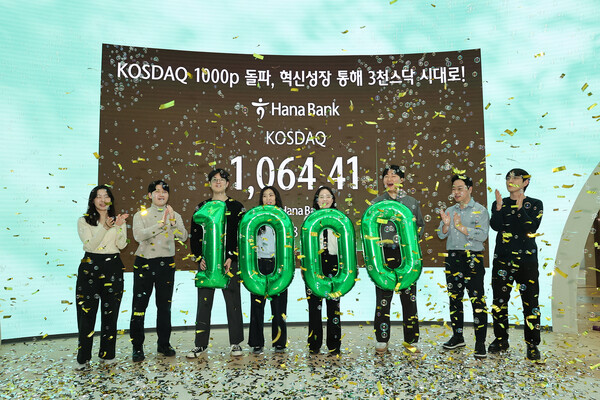
South Korea’s Kosdaq has entered the so-called “Cheonsdaq” era, topping 1,000, helped by expectations for government policies.
On Jan. 26, the Kosdaq index ended up 70.48 points, or 7.09 percent, at 1,064.41. The Korea Exchange said this was the highest close since Sept. 6, 2000, when it finished at 1,074.10, about 25 years and 5 months ago.
The index opened up 1.00 percent at 1,003.90. It regained the 1,000 mark for the first time since Jan. 6, 2022, when it stood at 1,003.01, and extended gains. It rose as high as 1,064.44 at one point.
With expectations for government Kosdaq policies continuing, strength in biotech and secondary battery shares lifted the index, the market atmosphere suggests.
Reports said the KOSPI 5000 Special Committee proposed reaching a 3,000 level on the Kosdaq by using digital assets at a luncheon with President Lee Jae-myung (이재명) on Jan. 22.
The Kosdaq index then jumped 2.4 percent and quickly surged to the 990 level. Policy expectations appear to have continued on the day.
Expectations of benefits for Kosdaq-listed companies are also rising from measures such as the “National Growth Fund”, which aims to invigorate investment in venture companies and venture capital and invest in advanced industries.
So far this month, the Kosdaq index has jumped 15 percent, already far exceeding the gain of last month, 1.4 percent.
Institutional investors have been mainly warming up the Kosdaq market.
From the start of the month through Jan. 26, institutional investors posted net purchases of 2.733 trillion won in the Kosdaq market, and foreigners bought 55 billion won. Retail investors, by contrast, posted net sales of 2.034 trillion won over the same period.
In particular, institutions’ net purchases on the day totalled 2.6 trillion won, the largest ever.
Institutional buying on the day was concentrated in secondary battery and biotech shares.
Institutions were the biggest net buyers of secondary battery stock EcoPro, purchasing 170 billion won. It was followed by EcoPro BM at 169 billion won, ABL Bio at 167 billion won and Alteogen at 153 billion won.
Retail investors, by contrast, saw the sharp Kosdaq surge as a chance to take profits and sold heavily.
Retail investors’ net sales on the day totalled 2.098 trillion won, the largest ever.
In the brokerage industry, forecasts are emerging that stock gains could accelerate further if the government’s policies to revitalise the Kosdaq are made concrete.
Kim Doo-eon (김두언), a researcher at Hana Securities, said, "Ahead of events that will determine the direction of global interest rates, policies to revitalise the Kosdaq are resurfacing." He added, "We should pay attention to the Kosdaq, which is sensitive to interest rates."
 Sang-yeop Oh
yub@d-today.co.kr
Sang-yeop Oh
yub@d-today.co.kr