
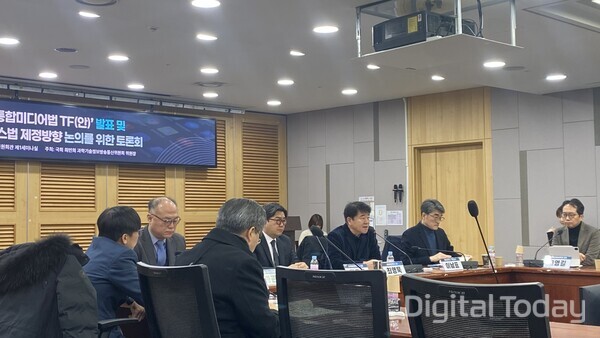
South Korea's National Assembly is set to overhaul its transmission-centred media regulatory system, for the first time in 26 years since an integrated broadcasting law was enacted in 2000. It aims to build an influence-centred legal framework that covers OTT services such as Netflix and YouTube, and later encompasses artificial intelligence content.
The National Assembly's Science, ICT, Broadcasting and Communications Committee on Jan. 26 held a forum on an integrated media law at the lawmakers' office building in Yeouido and unveiled a draft tentatively titled the Audiovisual Media Services Act. The bill is the result of 16 meetings over the past seven months by a task force launched in June last year under committee chair Choi Min-hee (최민희).
Removing transmission-based categories and regulating by social impact is at the core of the bill.
Kwon Oh-sang (권오상), head of the Digital Future Research Institute, who presented at the forum, said the current law is bound by a definition of "transmission" at a 1990s level. Splitting laws based on whether content is sent over airwaves, such as terrestrial broadcasting, or over wired networks, such as IPTV, creates regulatory blind spots in a changing environment, he said.
The draft bill integrates all media into a single category of "audiovisual media services". The name is taken from the European Union's Audiovisual Media Services Directive (AVMSD). It would use content programming and placement, and social influence, as regulatory measures rather than technical delivery methods.
Another feature is separating the sector into "public" and "market" domains. The public domain would include public broadcasters KBS, MBC and EBS, terrestrial broadcasters and news channels. Because their political and social impact is large, the bill would keep the existing licensing and approval system, while proposing a six-year agreement system for public broadcasters to strengthen public responsibilities and link it to funding issues.
The market domain would include OTT services, platforms, general channels and big YouTubers. It would abolish compartmentalised genre regulation such as the current comprehensive programming and specialised programming categories. It would also shift advertising rules to a negative approach that allows advertising in principle but prohibits exceptions.
It would also bring a small number of user-generated content channels and YouTube channels with influence comparable to legacy media under the law to ensure fairness.
The draft includes a legal basis for assessing the business status of global OTT operators, including sales and finances. Domestic sales of global platforms such as YouTube and Netflix currently rely on estimates, which has fuelled disputes over fairness.
Kim Nam-doo (김남두), a research fellow at the Korea Information Society Development Institute, said that unlike broadcasters, OTT operators lack a system for collecting accounting information, reducing market transparency. He stressed the need to find a compromise to introduce a financial status disclosure system for global OTT operators comparable to that for broadcasters. The idea is to improve a structure in which only domestic operators face reverse discrimination and to strengthen market monitoring.
The draft also stipulates the establishment of a national basic plan for media development, elevating media industry investment and talent development to national tasks. Lee Jong-gwan (이종관), a senior specialist committee member at law firm Shin & Kim, said the impact of sharp increases in OTT fees on the market is significant, calling for a policy approach based on an influence-centred proportionality principle.
Regulation of "AI media" was not included in this draft. Chae Young-gil (채영길), a professor at Hankuk University of Foreign Studies, said AI media is a completely new area and was difficult to cover in the current discussions. He advised that the Broadcasting, Media and Communications Committee should be able to present a proactive policy model beyond ex post regulation. The National Assembly and the task force plan to set this as a second-stage legislative task requiring social consensus and to supplement it over time.
Panelists called for policy leadership that goes beyond jurisdictional disputes among ministries to ensure the integrated media law succeeds. Noh Chang-hee (노창희), head of the Digital Industry Policy Research Institute, said the current Broadcasting Act lags too far behind the technological environment. He stressed that clearly distinguishing between public and private domains is needed to address gaps between technological development and regulation.
Shim Woo-min (심우민), an associate professor at Gyeongin National University of Education, said merging laws should not become an end in itself. He said it is important to clarify the practical effects the integration will bring and to build social consensus in the process.
The National Assembly says it will speed up legislation starting with this forum. Hwang Jung-a (황정아), a lawmaker from the Democratic Party and a member of the committee, said now is the golden time to enact a media law. She said she will provide full support so that a proper bill reflecting environmental change can pass the 22nd National Assembly. She added the committee will proceed with legislative procedures at pace.
Separately, the Broadcasting, Media and Communications Committee is also leaving open the possibility of government legislation. Kim Hae-na (김해나), head of the committee's Media System Innovation Team, said work related to an integrated media legal system has been pursued continuously and the bill's contents are under review. She said possibilities are also being kept open for the process and method of pushing legislation.
 Seul-gi Son
sageson@d-today.co.kr
Seul-gi Son
sageson@d-today.co.kr