
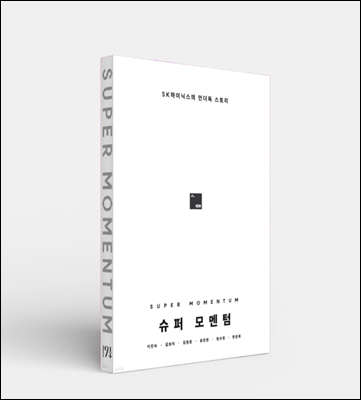
A book on SK hynix's HBM development process has been published. A book titled “Super Momentum” that traces the 20-year history of high-bandwidth memory (HBM) technology first developed by SK hynix was released on Jan. 26. The 260-page book describes how a chipmaker that had long been No. 2 rose to No. 1 with a core technology for the AI era.
The book includes interviews with current and former executives, including SK Group Chairman Chey Tae-won (최태원) and SK hynix CEO Kwak Noh-jung (곽노정). It also contains testimony from engineers who took part in early HBM development. The authors are Lee In-sook (이인숙), Kim Bo-mi (김보미), Kim Won-jang (김원장), Yoo Min-young (유민영), Lim Soo-jung (임수정) and Han Woon-hee (한운희).
Chapter 1, “A decisive move, changing the game”, covers management strategy after Chey acquired Hynix. Chey met one-on-one with 100 executives soon after the acquisition and combined SK’s systems with Hynix’s technological capabilities. The book introduces the decision-making process behind bold calls, including a decision to invest in a new fab for the first time in 18 years. It explains the background to Hynix DNA described as “toughness” formed through crises, a “one team” culture and “top team” leadership.
Chapter 2, “Building persistence to break through walls”, reconstructs the full development process of HBM technology by period. It records early research on through-silicon via (TSV) in 2006, a first HBM alliance with AMD in 2008, and an initial prototype internally called “HBM 0”. It also covers how “HBM2 Gen2”, redesigned after failures, became the foundation of HBM in the AI era. The technical challenges and development episodes of HBM2E, HBM3 and HBM3E are described in detail.
Chapter 3, “Drawing a big dream again”, covers the future strategy of Hynix after becoming the No. 1 company. It presents the company’s future direction after shifting from commodity memory to a core solution in the AI ecosystem. Through an interview with Professor Kwon Seok-joon (권석준) of Sungkyunkwan University, it forecasts changes in semiconductor technology and the market. The book’s final chapter includes an in-depth interview with Chey titled “Chey Tae-won Note”.
Chey said, “The core of the HBM story is AI,” adding, “We were standing at a crossroads.” He explained that the company achieved technological differentiation by focusing on server DRAM, and quickly captured the market as major customers shifted to AI. He then said, “The impact created by AI semiconductors so far is only a prelude.” The book also includes episodes such as the moment he first met Nvidia CEO Jensen Huang at Nvidia headquarters in 2021 and receiving advice from TSMC founder Morris Chang.
Hynix forecasts the global semiconductor market will be $1 trillion in 2026. Chey met the authors in August 2025 and presented a target market capitalisation for Hynix in 2030 of 700 trillion won. It describes Hynix’s future in terms of market capitalisations of 1,000 trillion won and 2,000 trillion won. The cover visualises an HBM design similar to its actual size. The price is 22,000 won.
 Daegeon Seok
d2dg@d-today.co.kr
Daegeon Seok
d2dg@d-today.co.kr