
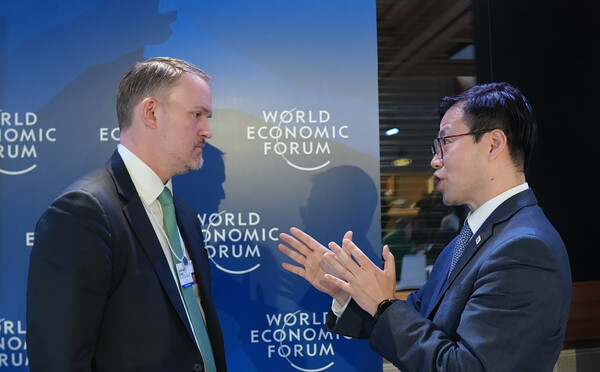
Yeo Han-koo, South Korea's chief trade negotiator, launched broad trade diplomacy at the Davos forum, holding about 50 meetings with trade ministers and business leaders from major countries. The Ministry of Trade, Industry and Energy said on Jan. 23 that Yeo attended the 2026 World Economic Forum annual meeting in Davos, Switzerland, to work on resolving trade issues and attracting global investment.
The forum drew a record number of government and business figures under the theme "the spirit of dialogue" amid global uncertainty. Discussions covered a range of areas including trade and investment, as well as artificial intelligence, critical minerals and digital issues.
Yeo met U.S. Trade Representative Greer to exchange views on Korea-U.S. trade issues and agreed to maintain close communication to manage bilateral trade ties in a stable way. He told key figures including Michigan Governor Whitmer, California Governor Newsom, Kentucky Governor Beshear and Senator Coons that South Korean companies contribute through investment in the United States and that mutually beneficial industrial cooperation should be strengthened.
He also focused on steel import restriction issues. With EU trade commissioner Sefcovic, he discussed plans to hold talks to produce effective solutions to the EU's steel import restriction measures. He urged Canadian Trade Minister Sidhu to prepare a solution to Canada's steel import restrictions, while sharing the status of the EU's trade response toward the United States related to Greenland with French minister delegate for trade Forissier and Swiss State Secretary for Economic Affairs Budliger Artieda.
He also actively pushed to speed up FTA negotiations to diversify trade networks. He discussed signing a GCC FTA with Gulf Cooperation Council Secretary-General Albudaiwi and Saudi Trade Minister Majid. He separately discussed speeding up FTA talks with Thailand with Thai Foreign Minister Sihasak and Thai Commerce Minister Suphaj, and the launch of Korea-Egypt CEPA negotiations with Egyptian Minister of Investment and Trade El-Khatib. He also held talks on FTAs and trade agreements with Mongolian Prime Minister Jandanshatar, Bangladesh prime minister's special envoy Siddiqui, and Argentine deputy minister Brun.
Yeo also met chief executives of major foreign-invested companies including Merck, Apple, Orsted, AstraZeneca, Coca-Cola, Amazon Web Services, Maersk and Trafigura. He explained South Korea's policies to foster new industries such as AI and its commitment to supporting foreign-invested companies, and asked for increased investment in the country. He also met global scholars including Professor Chris Miller, author of "Chip War", Professor Yoshua Bengio of the University of Montreal and Eurasia Group President Ian Bremmer.
◆ Standing out on the diplomatic stage for multilateral trade order beyond the bilateral framework
Yeo moved to restore the multilateral trading order by attending a WTO trade ministers' meeting and chairing a meeting on the Investment Facilitation Agreement on the sidelines of the 2026 World Economic Forum annual meeting in Davos, Switzerland.
Yeo attended an informal WTO trade ministers' meeting hosted by the Swiss government, where he discussed ways to deliver outcomes at the 14th WTO Ministerial Conference scheduled for March with ministers from more than 20 countries including the United States, the European Union, China and Japan. Key agenda items included incorporating plurilateral agreements such as investment facilitation into the WTO and extending the e-commerce moratorium, and the meeting also addressed the direction of WTO reform.
Yeo stressed that the upcoming ministerial conference would be a test of trust and relevance for the WTO. He argued that rule-making through plurilateral agreements is a realistic alternative. He expressed his intention to play a leading role so that the Investment Facilitation Agreement led by South Korea can be adopted as an official agreement under the WTO system.
He chaired a breakfast meeting of ministers from countries that support the Investment Facilitation Agreement and discussed systematic and strategic outreach to incorporate the agreement into the WTO system. In a meeting with WTO Director-General Ngozi Okonjo-Iweala, he said South Korea, as a beneficiary of the multilateral trading system, would actively play roles such as coordinator at the ministerial conference. He said South Korea would contribute constructively to future WTO reform discussions.
Yeo served as a key speaker in various sessions held on the sidelines of the Davos forum on issues including AI, critical minerals supply chains and cooperation with emerging countries. He introduced South Korea's policy direction on AI, digital issues and supply chains and shared its willingness to cooperate globally.
Yeo said, "Through activities at the Davos forum, we saw that even under global uncertainty, the international community's interest in and demand for dialogue and cooperation remain high, and foreign investors' interest in Korea is substantial." He added, "While continuing coordination with major countries on pressing trade issues, we will actively push measures to expand foreign investment centered on national interests through communication with major foreign-invested companies, and we will also faithfully carry out the role of rule-maker to restore the multilateral order, including WTO reform and establishing new trade rules on AI and digital issues."
 Dae-gun Seok
d2dg@d-today.co.kr
Dae-gun Seok
d2dg@d-today.co.kr