
South Korea's financial authorities have completed preparations to activate a market stabilisation program worth more than 100 trillion won to shield financial markets from shocks as uncertainty grows due to a prolonged Middle East situation.
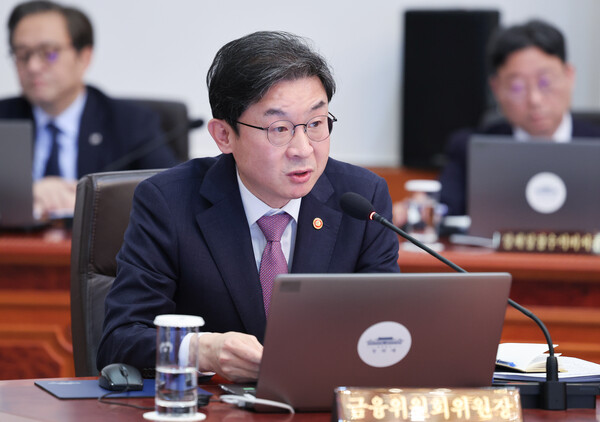
Financial Services Commission Chairman Lee Eok-won (이억원) said at an emergency Cabinet meeting at Cheong Wa Dae on Wednesday that the prolonged Middle East situation could affect domestic financial markets and the real economy. He said authorities must closely watch developments with heightened vigilance. He said the 100 trillion won-plus market stabilisation program currently in operation would be actively run if excessive market volatility occurs.
President Lee Jae-myung (이재명), who chaired the emergency Cabinet meeting on Wednesday morning, said policy efforts should be accelerated to stabilise capital markets and improve their structure. He ordered the swift execution of a 100 trillion won market stabilisation program to pre-empt funding market instability.
The financial authorities immediately activated an emergency financial markets team headed by the FSC secretary general. The team, which includes the Ministry of Finance and Economy, the Bank of Korea and the Financial Supervisory Service, will monitor domestic and global market trends around the clock and maintain an emergency response posture.
Lee ordered the swift implementation of contingency plans, including the already-prepared 100 trillion won-plus market stabilisation program.
On the stock market, he said high volatility in local shares was mainly driven by risk-off sentiment due to Middle East uncertainty and demand to take profits. He said experts see short-term volatility and uncertain developments, but assess the possibility of a sustained decline as low when taking into account corporate earnings, government policy and fund inflows.
He said he gathered views from brokerage research heads, who said valuations and corporate earnings that have driven the rise in local shares had not changed despite a Middle East shock. He added that they urged the government to show a firm commitment to stability so investors can make rational decisions based on trust in South Korea's financial markets rather than excessive anxiety.
 Oh Sang-yup
yub@d-today.co.kr
Oh Sang-yup
yub@d-today.co.kr