
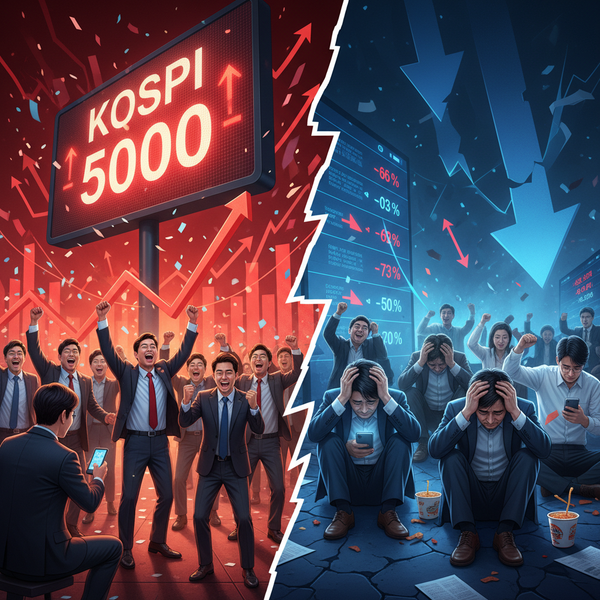
[DigitalToday reporter Sang-yeop Oh (오상엽)] South Korea's KOSPI wrote a new chapter in market history by breaking above 5,000 points for the first time. Foreign investors scooped up semiconductor and artificial intelligence (AI) shares, driving the index higher. Retail investors who bet on a decline are nursing heavy losses, highlighting a stark divide.
On Jan. 22, the KOSPI jumped as high as 5,019.54 during the session, crossing the 5,000 mark for the first time. That was driven by strong foreign buying that has continued since the start of 2026.
Looking at trading by investor group over the past month (Dec. 23, 2025 to Jan. 22, 2026), foreigners led the index higher with net purchases of 4.4 trillion won. Institutions also added support by buying 286.7 billion won.
Retail investors, meanwhile, net sold 6.46 trillion won over the same period, moving to take profits or bet on a market decline.
The issue is that retail money is concentrating in 'inverse' products that track declines in the index. Even though losses grow as the index rises, retail investors expected a pullback due to fatigue after the short-term surge and moved into contrarian trades.
According to financial data firm ETFCheck, retail investors have been buying exchange-traded funds (ETFs) that bet on a market decline.
In particular, 'KODEX 200 Futures Inverse 2X', which tracks twice the inverse of the daily move in the KOSPI 200 index, saw 428.3 billion won of net retail inflows since the start of the year. That places it among the top ETFs by net inflows.
Over the same period, 'KODEX Inverse' drew 154.1 billion won, while 'TIGER 200 Futures Inverse 2X' took in 18.3 billion won. Retail buying focused on so-called leveraged inverse products, which post losses twice as large when the index rises.
As the KOSPI extends its rally toward 5,000, retail accounts that bet on a fall have turned deep into the red.
As of Jan. 22, year-to-date returns for major inverse ETFs are at grim levels.
'KODEX 200 Futures Inverse 2X' posted a return of minus 30.24 percent. In less than a month, about one-third of the principal has effectively evaporated. 'TIGER 200 Futures Inverse 2X', which has the same structure, also struggled with a return of minus 29.95 percent.
Conventional inverse products that track the index one-for-one also showed similar results. 'KODEX Inverse' is down 16.05 percent and 'TIGER Inverse' is down 17.09 percent.
In the brokerage industry, the view is that the KOSPI's uptrend could continue for the time being. That is because signs of a global economic recovery and the emergence of the AI industry are leading to improved performance at domestic semiconductor companies.
An official in the investment industry advised that the KOSPI era of 5,000 reflects a valuation re-rating that differs from the past. The official said foreign flows are supporting the market and companies' earnings forecasts are being revised higher, calling for a strategy that follows the trend rather than premature calls on a peak.
The official added that, particularly for leveraged inverse products, a negative compounding effect can produce losses when volatility is high even if the index returns to where it started. The official warned that approaching such products as simple directional bets, rather than for short-term hedging, is very risky.
 Sang-yeop Oh
yub@d-today.co.kr
Sang-yeop Oh
yub@d-today.co.kr