
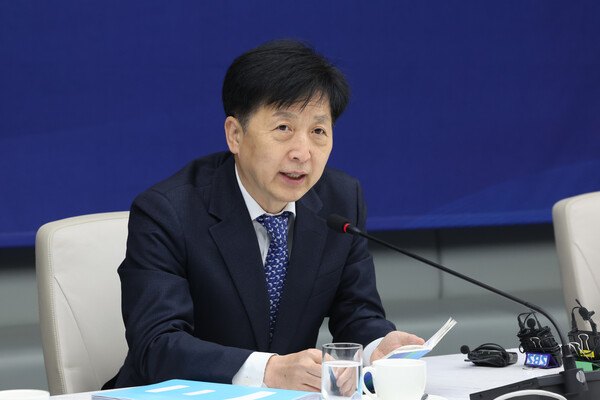
The Democratic Party’s KOSPI 5000 Special Committee said on Thursday it won agreement to move quickly on a third revision of the Commercial Code after having lunch with President Lee Jae-myung at Cheong Wa Dae.
Committee chair Oh Ki-hyung (오기형) said the party and Cheong Wa Dae shared the view that efforts on institutional reform should continue to strengthen the underlying strength of the capital market.
On the third Commercial Code revision bill, whose centerpiece is making it mandatory to cancel treasury shares, he said there was agreement that it should not be delayed further. He said they decided to communicate and persuade in various venues at home and abroad.
On the KOSPI breaking above 5,000 during intraday trade for the first time, he said it was significant in that it fulfilled Lee’s presidential campaign pledge. He said it was the result of consistent policy resolve, noting that Lee had created a “capital market revitalisation task force” and pursued legal revisions since his time as party leader.
Oh said the committee’s own review found the KOSPI price-to-book ratio rose from 0.9 at the end of 2024 to an estimated 1.6 on Thursday. He said the emerging-market average was about 2.2 and advanced markets were around 4.01.
He said the Korea discount had been eased significantly but not completely, as it still had not reached the emerging-market average. He stressed that continued institutional reform was needed to move toward an era of a Korea premium.
Oh said the luncheon discussions also covered a so-called stock-price suppression prevention law and the issue of duplicate listings.
He said unlisted companies are subject to inheritance tax based on assets, but listed companies are taxed based on market value, leading firms to suppress share prices to reduce inheritance taxes. He said lawmakers Lee So-young and Kim Young-hwan led the discussion, adding that there was a view to push it forward as it drew broad agreement.
On duplicate listings, such as a listed parent company spinning off and separately listing a highly profitable unit, he said there was talk that it should be looked at strictly and that related institutional improvements should be considered more actively.
 Sangyeop Oh
yub@d-today.co.kr
Sangyeop Oh
yub@d-today.co.kr