
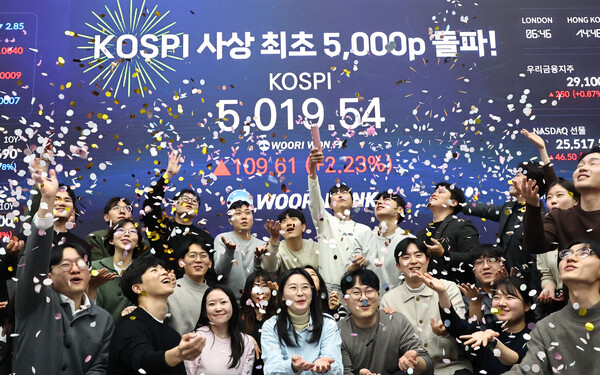
South Korea's stock market has finally reached the KOSPI 5,000 level, long dubbed a "dream index". A semiconductor supercycle and momentum in robot stocks combined to lift the index. Politicians also lent support by proposing measures such as tax benefits.
According to the Korea Exchange on Jan. 22, the KOSPI at one point surged to 5,019.54, crossing 5,000 for the first time. It later gave back some gains and closed at 4,952.53, up 42.60 points, or 0.87 percent, from the previous session. The intraday touch of 5,000 was a first in the history of South Korea's stock market.
Semiconductors were the clear driving force behind the rally. Samsung Electronics topped 150,000 won in intraday trading. SK Hynix is moving beyond the 700,000 won range and is trying to enter 800,000 won.
Shares reflected expectations for results as orders for high-bandwidth memory, or HBM, and enterprise solid-state drives, or eSSD, poured in on a surge in demand from artificial intelligence data centres.
Brokerages set target prices as high as 200,000 won for Samsung Electronics and up to 1.12 million won for SK Hynix, and analysed that "the peak of the semiconductor supercycle has not yet arrived".
When semiconductors paused to catch their breath, automotive and defence stocks took over.
Hyundai Motor has surged more than 70 percent since it unveiled its humanoid robot, Atlas, at CES 2026 on Jan. 6. Over the same period, defence stocks such as Hanwha Aerospace, up 36.3 percent, and Korea Aerospace Industries, up 41.9 percent, also drove the index higher by landing big orders amid a global geopolitical crisis.
The KOSPI's advance stands out among major global stock markets.
After jumping 75.6 percent last year to rank first among G20 and OECD member countries, it is also leading this year with a 17.52 percent rise. That outpaces gains over the same period in Japan's Nikkei, up 6.79 percent, and the U.S. S&P 500, up 0.44 percent.
Domestic and foreign brokerages are raising KOSPI targets in unison. Korea Investment & Securities raised its upper target to 5,560, and Hyundai Motor Securities forecast a break above 5,500.
Foreign brokerages Macquarie Securities and JPMorgan even offered a rosy outlook that "the KOSPI will approach 6,000 on the back of strong earnings growth and ample liquidity".
But it remains a challenge that outside the flashy semiconductor sector, listed companies are showing only limited improvement in earnings.
Forecast operating profit for 254 KOSPI-listed firms excluding Samsung Electronics and SK Hynix rose just 3.8 percent from three months ago. Over the same period, profit forecasts for the electrical and electronics sector jumped 141 percent.
Lee Jae-man (이재만), a researcher at Hana Securities, warned of a concentration in specific stocks, saying Samsung Electronics and SK Hynix are expected to account for 47 percent of KOSPI net profit in 2026.
Policy support to cement the KOSPI 5,000 era is also accelerating. The Democratic Party proposed legislation on the day to introduce "return-to-domestic-market accounts (RIA)" to help bring home funds invested in overseas stocks.
The proposal offers income deductions of up to 100 percent for capital gains on overseas stocks if investors convert proceeds from selling overseas shares into won and invest in the domestic stock market for at least 1 year, with the maximum benefit applying if they return within the first quarter.
Another plan is being 추진 to offer separate taxation of dividend income at 9 percent and income deductions of up to 40 percent of the investment amount for those who invest for at least 3 years in a "public participation growth fund" scheduled to launch in June to July. This is interpreted as a move aimed at stabilising the won-dollar exchange rate, which has recently surged to the 1,480 won range, and strengthening supply and demand in the domestic stock market.
An official in the financial investment industry said, "Now the basic thinking about the stock market must also change," adding, "Until now it was a market where companies raised capital, but going forward it must become a market where individuals accumulate assets to be able to see what comes after 5,000."
The official added, "Given that this rally was possible because retail investors have become more sophisticated, conditions should be created for existing media and investors to criticise messages that mislead retail investors, such as some YouTube channels or so-called leading rooms."
 Sang-yeop Oh
yub@d-today.co.kr
Sang-yeop Oh
yub@d-today.co.kr