
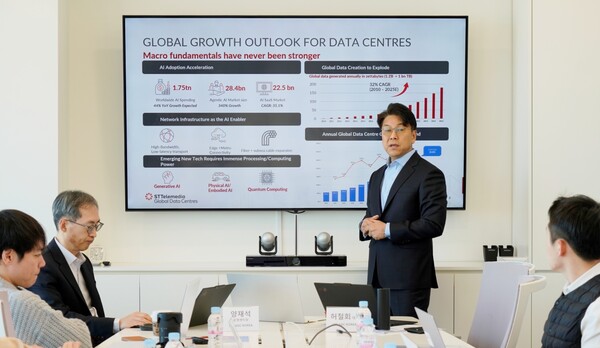
[Digital Today reporter Chi-gyu Hwang] STT GDC, a global data centre specialist headquartered in Singapore, will open a data centre in Seoul in June and begin full-scale operations.
STT GDC Korea, a joint venture between STT GDC and Hyosung Heavy Industries, has completed the AI-ready data centre "STT Seoul 1" in Gasan-dong, Geumcheon district, Seoul, and plans to start service in June 2026.
STT GDC is highlighting data centre thermal management as a differentiator. It is working with technology partners, research institutions and specialist companies to develop solutions that can meet cooling requirements for AI infrastructure.
In addition to conventional air cooling and D2C (direct-to-chip) liquid cooling, which is spreading for cooling AI infrastructure that generates high heat, it is also expanding investment in immersion cooling, which remains at the test stage but is seen as a next-generation technology. It also worked with Schneider Electric and ICEOTOPE on an immersion-cooling proof-of-concept.
STT GDC expects the South Korean market to grow quickly around the AI and cloud industries and plans to step up efforts to target domestic and overseas hyperscalers.
STT GDC is also pursuing a vision of carbon-neutral operations by 2030 at the global level through immersion cooling, AI-based energy optimisation and expanding renewable energy, and plans to actively extend and apply this strategy to the South Korean market.
STT GDC is also taking a positive view of the potential of immersion cooling. Immersion cooling is a method that rapidly cools heat by directly submerging servers or electronic components in a special insulating coolant. Compared with D2C, which sends coolant directly over the chip surface, it can be more effective, but a drawback is that it is still difficult to implement in real-world operations. D2C can be applied to some extent even in data centres built on air-cooling, but immersion cooling is not easy to do so.
Heo Cheol-hee (허철희), head of STT GDT Korea, said, "Air cooling can cover power capacity up to 40 kilowatts, but more than that is difficult. With D2C, it is possible to cool ultra-high-density infrastructure of up to 100 kilowatts. But if it goes beyond 100 kilowatts, it is a different story. There is no choice but to immerse the rack." He added, "It is still in the test stage and there are not many commercialisation cases, but it will evolve into a next-generation cooling method." He added, "From the perspective of operations managers, immersion cooling has no noise. It can realise a quiet data centre."
One of the reasons immersion cooling has been slow to spread is not unrelated to Nvidia's stance.
Yang Jae-seok (양재석), head of the operations centre at STT GDC Korea, said, "Nvidia is not yet providing a warranty for immersion cooling. But chips Nvidia will release in the future will require D2C. In the end, I think it will accept it." He said he expects moves to commercialise immersion cooling to become more concrete within the next five years.
 Chi-gyu Hwang
delight@d-today.co.kr
Chi-gyu Hwang
delight@d-today.co.kr