
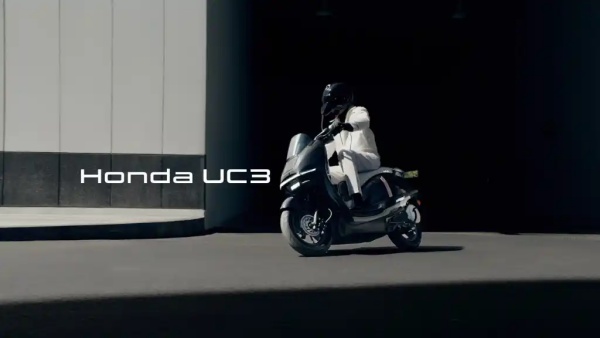
[DigitalToday reporter Jinju Hong (홍진주)] Japan's Honda is accelerating the pace of electric two-wheeler launches, making up for past sluggish electrification. Its latest electric scooter, the UC3, is due to be introduced soon in Vietnam and Thailand and is seen as a strategic model targeting everyday transport in major Asian cities. The UC3 is also drawing attention for adopting a fixed battery instead of the swappable batteries Honda has long stuck with.
According to Electric on Jan. 21 (local time), the UC3 is an electric scooter introduced by Honda's motorcycle division and, by Western-market standards, has a character closer to a scooter. The model is designed as an electric replacement for a 110cc gasoline engine, and Honda begins full-scale sales in Thailand and Vietnam from this spring. It is targeting electrification demand in Southeast Asia, where tens of millions of gasoline scooters are in use.
Policy changes by the Vietnamese government also played a role in the launch. Vietnam is pushing to restrict the operation of gasoline two-wheelers in major cities including Hanoi and Ho Chi Minh City to reduce air pollution and traffic congestion. As a result, electric two-wheelers are emerging as a necessity rather than a choice, and Honda's UC3 launch is interpreted as a direct response to this trend.
Technically, the UC3 is Honda's first to be fitted with a fixed lithium iron phosphate (LFP) battery. The battery has a capacity of 3.2 kWh, offers a maximum range of 122 km under the WMTC standard and has a top speed of 80 km/h. It uses an in-house wheel motor developed by Honda, with peak output reaching 6 kW. It also includes three riding modes and a reverse function useful in tight spaces.
The battery strategy is particularly notable. Honda has preferred swappable batteries for lightweight electric two-wheelers and has built the Honda Mobile Power Pack e: system and battery swap stations across Asia. Unlike that approach, the UC3 electric scooter adopts a fixed battery, simplifying the vehicle structure and responding to market conditions where home and workplace charging environments are spreading.
The UC3 uses a fixed battery, allowing only onboard charging, similar to electric vehicle charging. Honda, however, is not abandoning its swappable-battery strategy and plans to keep expanding its existing battery swap stations alongside the UC3 launch. It is based on a judgment that swappable batteries may still be efficient for delivery riders or in densely built-up urban areas.
Charging infrastructure will also be built in parallel. Honda plans to install CHAdeMO-based electric two-wheeler chargers, using an electric-vehicle fast-charging standard system, at dealerships and shopping centers in Thailand and Vietnam, and in Vietnam it is set to begin full-scale operations from mid-2026. The industry sees the UC3 as a model symbolising Honda's dual battery strategy and expects it to strengthen Honda's position in Asia's electric two-wheeler market.
 Jinju Hong
hongjj@d-today.co.kr
Jinju Hong
hongjj@d-today.co.kr