
[Barcelona, Spain=DigitalToday reporter Jin-ho Lee] LG Uplus declared it will move beyond telecommunications and become an artificial intelligence (AI) software company. It will expand its voice AI software business and pursue entry into global markets.
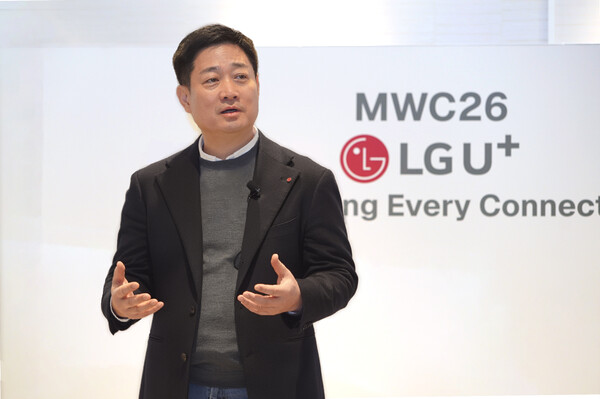
Hong Beom-sik (홍범식), chief executive officer of LG Uplus, said at an MWC26 media briefing in Barcelona on March 4 (local time) that the company aims to become an AI-centric software company leading the solutionisation of telecommunications and AX technologies. He said it will enter global markets through technological capabilities and partnerships.
◆"Fundamentals, customer value, AI investment, global" ... mid- to long-term vision presented
Hong said LG Uplus last year focused on four strategies: strengthening fundamentals, innovating customer value, investing in AI infrastructure and expanding globally.
He stressed that security, quality and safety are a telecom operator's core competitiveness and fundamental capability. "As a national key telecommunications business operator, security, quality and safety are fundamentals we cannot compromise," Hong said. "I became convinced that investment beyond a threshold is needed for public convenience, not simply from a profit perspective," he said.
The same applies to innovation in customer experience. He said a bigger leap requires providing a service experience that does not inconvenience customers and lets them feel reassured. Hong also stressed that AI infrastructure such as AI data centres (DC), graphics processing units (GPU) and large language models (LLM) is becoming central to national competitiveness.
In a situation where growth in the telecommunications market has slowed, Hong's plan is to find the funding needed to invest in AI infrastructure from "global" expansion. "Promoting global expansion is an important task to prepare for the AI era," he said. "We want to enter the global software business," he said.
◆Targeting global markets with voice AI 'ixi-O'
LG Uplus presented the voice AI-based service 'ixi-O' as a key pillar of its push into global markets. Ixi-O is an AI call agent that uses voice data to understand conversational context and emotions and provide services.
Hong has stressed through an MWC26 keynote speech that in the physical AI era led by robots and wearables, voice will be a key interface. "I think telecom operators have the strongest source data competitiveness in connecting voice to voice," he said.
LG Uplus is seeking to expand globally through a two-track approach: supplying the ixi-O service itself or providing an AI technology stack. LG Uplus is currently discussing ixi-O expansion with 13 overseas telecom operators.
Hong said it could take time due to regulatory environments and technical differences, but he expects exports to be possible from 2027. LG Uplus expects to produce results first in Southeast Asian markets rather than Europe, where regulations are relatively strict.
◆Expanding B2B markets with AICC and AI data centres
In the B2B market, it will pursue a growth strategy centred on AI-based contact centres (AICC) and the AI DC business.
Last year, LG Uplus' AICC business doubled in revenue terms. Hong said telecom operators run the most complex contact-centre environments, and that experience can be extended to contact centres in other industries.
For the AI DC business, it is pinning hopes on the Paju AI DC. It plans to expand its DBO (Design·Build·Operate) business that carries out the entire process of designing, building and operating customers' data centres, using the Paju AI DC, scheduled for completion in 2027, as a starting point.
In its core telecommunications business, it plans to collaborate with operators leading the market in four areas: AI services, lifestyle, media and financial. For networks (NW), it plans to lead the market by securing future technologies such as 5G standalone mode and AI-RAN in a timely manner, and by using autonomous network solutions that optimise networks through AI.
 Jin-ho Lee
jhlee26@d-today.co.kr
Jin-ho Lee
jhlee26@d-today.co.kr