
South Korea's economy grew 1 percent last year amid weak domestic demand including construction and facilities investment.
The figure matches the 1.0 percent forecast released by the Bank of Korea last November. It is about half the previous year's 2.0 percent and well below potential growth estimated at around 1.8 percent.
The Bank of Korea said on Wednesday that real gross domestic product (GDP) growth for the fourth quarter of 2025, preliminary and quarter on quarter, was calculated at minus 0.3 percent.
Quarterly growth hit 1.2 percent in the first quarter of 2024, then fell to minus 0.2 percent in the second quarter. It stagnated at 0.1 percent in both the third and fourth quarters before slipping back to minus 0.2 percent in the first quarter of last year.
It then rebounded in the second quarter at 0.7 percent and posted a 'surprise' 1.3 percent in the third quarter, but returned to negative growth in the fourth quarter.
The fourth-quarter reading was 0.5 percentage points below the estimate the central bank presented two months earlier of 0.2 percent. It was the lowest in 3 years since the fourth quarter of 2022, when it was minus 0.4 percent.
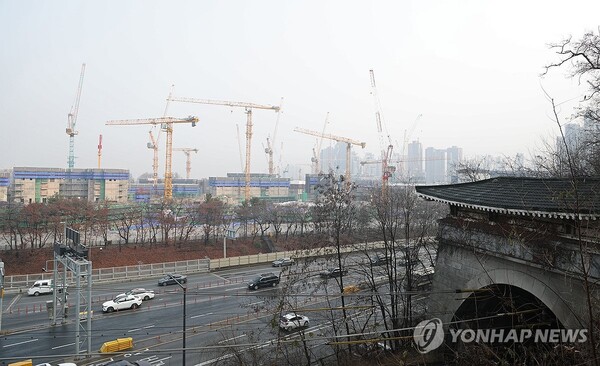
The central bank cites a base effect from the high third-quarter growth rate and a slump in construction investment as reasons for the fourth-quarter decline.
But because the gap with the estimate is large, criticism is expected that the central bank's outlook was overly optimistic from the start.
By sector in the fourth quarter, private consumption rose 0.3 percent from the third quarter, driven by services such as medical care despite a decline in goods including passenger cars. Government consumption also increased 0.6 percent, mainly due to health insurance benefit payments.
Construction investment fell 3.9 percent as both building and civil engineering construction were weak. Facilities investment also slipped 1.8 percent, led by transport equipment such as automobiles.
Exports shrank 2.1 percent as automobiles, machinery and equipment declined. Imports also fell 1.7 percent, led by natural gas and automobiles.
In terms of contributions to fourth-quarter growth, domestic demand and net exports (exports minus imports) were calculated at minus 0.1 percentage points and minus 0.2 percentage points, respectively. That means they pulled down the growth rate by that amount.
Domestic demand's contribution in particular plunged 1.3 percentage points from the previous third quarter, when it was 1.2 percentage points.
Within domestic demand, construction investment and facilities investment each shaved 0.5 percentage points and 0.2 percentage points off growth. By contrast, private consumption and government consumption each contributed 0.1 percentage points to growth.
By industry, manufacturing fell 1.5 percent due to weakness in transport equipment, machinery and equipment. Electricity, gas and water supply plunged 9.2 percent, led by the electricity sector. Construction also contracted 5 percent. Agriculture, forestry and fisheries rose 4.6 percent and services increased 0.6 percent.
The rise in real gross domestic income (GDI) in the fourth quarter of last year was 0.8 percent, exceeding the real GDP growth rate of minus 0.3 percent.
[Yonhap News Agency]
 Online Team
d-today@d-today.co.kr
Online Team
d-today@d-today.co.kr