
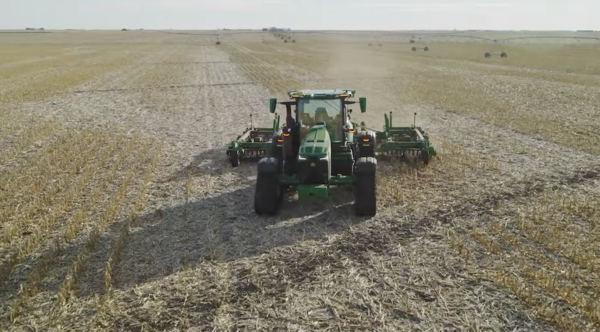
Autonomous driving technology is being commercialised faster on farms and construction sites than on public roads. As progress in urban autonomous driving is slow due to regulation and safety issues, controlled environments with fewer pedestrians and unexpected variables are emerging as new markets.
Overseas, agricultural machinery and construction equipment companies are already speeding up commercialisation of autonomous driving technology. U.S. farm equipment maker John Deere began distributing fully autonomous tractors to farms after unveiling one at CES in 2022. The Wall Street Journal (WSJ) described John Deere as "not an agricultural machinery company but an AI robotics company".
The mining sector is similar. Caterpillar has operated autonomous mining dump trucks for more than 10 years, advancing the technology. According to Caterpillar, autonomous mining trucks are 30 percent more productive than manned trucks. They can operate without 24-hour shift work and have lower accident rates, becoming an alternative to people in dangerous mining work.
These companies chose farms and mines because conditions on site are predictable. On farms or in mines, there are no pedestrians suddenly appearing, and repetitive work takes place within defined areas, making them optimal test beds for autonomous driving. With a food security crisis, rural ageing and avoidance of dangerous work converging, demand for automation continues to rise.
South Korean companies are also accelerating the adoption of on-site autonomous driving equipment as AI technology spreads. According to Rural Development Administration statistics, the domestic mechanisation rate in agriculture reaches 98 percent for rice farming, but stands at 67 percent for field farming and 31 percent for orchards. Many tasks still have to be done directly by people.
Daedong obtained two New Technology Agricultural Machinery certifications from the Rural Development Administration at the same time, an industry first, for an autonomous transport robot and a combine. The autonomous combine automatically sets a route after harvesting the field perimeter once, and moves autonomously to a designated location when the grain tank is full. For work on a 10,000-pyeong rice field in a day, a farmer's direct driving time is reduced to about 2 hours.
Daedong also signed an agreement with Doosan Robotics to jointly develop an autonomous mobile manipulation robot (AMMR) specialised for smart farms. It is preparing to launch a Level 4 autonomous tractor in the first half of 2026. Since last year, it has collected about 500,000 photos of orchards and fields and about 3 million driving videos, securing the largest volume of agricultural data in South Korea.
In construction equipment, Doosan Bobcat unveiled an AI-based voice control technology, the 'Bobcat Jobsite Companion', at CES 2026, the first in the compact construction equipment industry. Workers can use voice commands to control about 50 functions, including equipment settings and engine speed. Based on its own large language model (LLM), it works even at sites with unstable network connections.
Doosan Bobcat also showcased the modular concept equipment 'LogX3', which allows flexible combinations of whether a cockpit is present and the power source, as well as a collision avoidance system. Scott Park (스캇 박), vice chairman of Doosan Bobcat, said, "We will create a new standard for construction sites by combining AI, electrification, autonomy and connectivity."
 Suk Dae-geon
d2dg@d-today.co.kr
Suk Dae-geon
d2dg@d-today.co.kr