
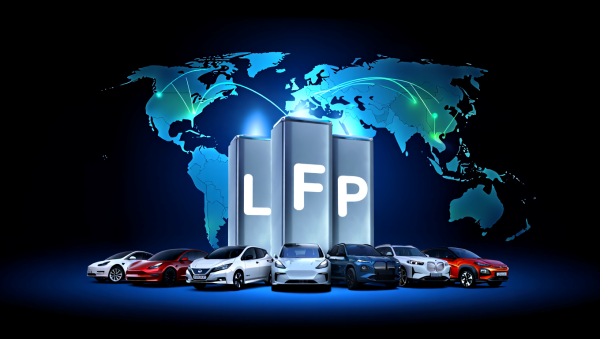
[DigitalToday reporter Jinju Hong (홍진주)] Low-cost lithium iron phosphate (LFP) batteries emerged as the core of the global EV battery market in 2025. According to market research firm RhoMotion, demand for LFP batteries surged 48% in 2025, overtaking nickel-based batteries to become the world’s most dominant battery chemistry.
On Jan. 20, EV outlet InsideEVs cited RhoMotion data as reporting that LFP batteries in 2025 became the leading chemistry for EV batteries for the first time, surpassing nickel-based batteries such as nickel-manganese-cobalt (NMC). It was a symbolic change showing the global battery industry structure is shifting in earnest.
Global automakers have relied on NMC batteries, which offer high energy density and are advantageous for driving range. In particular, most EVs sold in the United States have adopted NMC batteries. But the high costs and environmental burden from nickel and cobalt mining, and labour and human-rights issues that have been raised around the Democratic Republic of Congo (DRC), have increasingly weighed on the market.
Battery makers are therefore rapidly shifting to LFP chemistry, which does not use nickel. LFP is price-competitive and carries relatively lower supply-chain risk, and technological advances are also quickly narrowing the energy-density gap with NMC. As of last year, LFP batteries accounted for more than half of global EV battery deployments.
NMC batteries still have an edge in energy density, but automakers are seeking ways to overcome it through structural innovation. Cell-to-Pack and Cell-to-Chassis designs make it possible to pack more battery cells into the same space, and optimisation of cathode and anode materials is also helping narrow the performance gap.
China has an overwhelming advantage in LFP adoption. More than 80% of EVs sold in China from January to November last year were equipped with LFP batteries. That dominance is also spreading to overseas markets.
Europe and Asia excluding China accounted for about 75% of global LFP growth last year, mainly as Chinese EVs expanded into overseas markets. Bloomberg, citing Dataforce data, reported that Chinese automakers accounted for 12.8% of Europe’s EV market in November 2025, more than doubling their share from a year earlier. BYD, Leapmotor and Chery are showing rapid growth across Europe.
China’s largest battery company CATL is the dominant force in the LFP market, with about 1 in 3 EVs sold last year equipped with CATL batteries. CATL and BYD are also pushing local production in Europe to reduce tariff burdens and narrow distance with automakers. Both are building battery plants in Hungary, and CATL is operating a plant in Germany and, in cooperation with Stellantis, is also pushing to establish a plant in Spain.
North America was the only region where LFP battery deployments fell in 2025. The United States has effectively blocked inflows of Chinese batteries by applying tariffs and strict rules of origin through the Biden administration’s Inflation Reduction Act (IRA). As a result, the U.S. market has limited availability of EVs equipped with LFP batteries.
Tesla once applied LFP batteries to the base Model 3 in the United States, but halted that trim in 2024 due to tariff burdens. Rivian and Ford currently use LFP batteries in the R1S and R1T, and the base Mustang Mach-E. If the revival of the Chevrolet Bolt and the launch of Ford’s low-cost electric truck in the $30,000 range become reality, the possibility has been raised that LFP could spread again in the United States.
Even so, the centre of LFP expansion in the United States is likely to be battery energy storage systems (BESS), rather than passenger EVs. After the $7,500 federal EV tax credit ended, U.S. battery makers have been adjusting production strategies to target the fast-growing energy storage system market.
Tesla deployed 24,000 Megapacks through the third quarter of 2025, posting growth of 186% from a year earlier. Major battery companies including LG Energy Solution, Tesla and SK On are also reshaping manufacturing capacity around the energy storage system market, which is growing faster than EVs, and analysts say LFP battery deployments in the United States are likely to rise over the medium to long term.
 Jinju Hong
hongjj@d-today.co.kr
Jinju Hong
hongjj@d-today.co.kr