
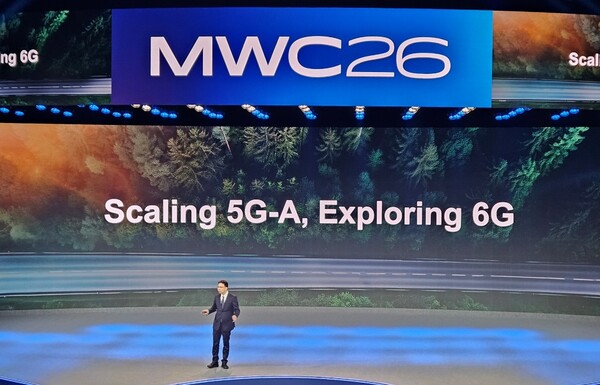
[Barcelona, Spain = Digital Today reporter Jin-ho Lee] Huawei presented large-scale commercialisation of 5G Advanced as a way to respond to the spread of artificial intelligence (AI). Discussions on 6G standards are under way, but Huawei said upgrading 5G Advanced should come first to respond immediately to surging AI demand.
Huawei Executive Vice President Yang Chaobin (양 차오빈) said in a keynote speech at MWC26 in Barcelona on March 3 (local time) that, "In general, the device and chipset camp wants early adoption of 6G, but operators judge it is still too early to introduce a new standard."
He cited cases from the recent Lunar New Year holiday period in China to highlight the pace of AI traffic growth. During the holiday, festival content using dance videos generated 1.9 billion interactions, and more than 50 million avatars were created on the night before Lunar New Year’s Day.
AI is also spreading quickly at industrial sites. More than 30 million AI agents are operating in industries such as manufacturing, finance and healthcare. By 2030, the volume of work handled by industrial agents is expected to rise by tens of thousands of times from current levels.
Yang said 5G Advanced would be a solution to this rise in AI demand. "AI will not wait," he said, adding that operators should use 5G Advanced networks to respond to growing AI demand.
With 5G Advanced, downlink speeds improve to 10 Gbps from 1 Gbps, and uplink speeds also rise to around 1 Gbps. "This can provide more diverse and flexible network capabilities," Yang said.
But for 5G Advanced to be effective, it requires efficient spectrum use. "2G, 3G, 4G, 5G and 5G Advanced coexist," he said, adding that regulatory flexibility should be secured so operators can freely choose the technology best suited to the spectrum they hold.
The global connectivity gap is also a challenge. In parts of East Asia, the Middle East and North America, 5G penetration has exceeded 50 percent, but parts of Africa and Latin America are still centred on 2G. Until recently, more than 300 million people have been unable to access mobile networks.
"As AI grows rapidly, the gap could widen instead," Yang said, adding that inclusive connectivity should be provided through diverse spectrum portfolios and cost-efficient solutions. Huawei’s RuralStar solution has been deployed in more than 80 countries, providing 170 million people with opportunities for mobile access.
"Over the next 5 years, we should meet demand for AI services through large-scale commercialisation of 5G," Yang said, again stressing that most use cases and candidate technologies discussed by the 6G camp can already be implemented with 5G Advanced.
 Jin-ho Lee
jhlee26@d-today.co.kr
Jin-ho Lee
jhlee26@d-today.co.kr