
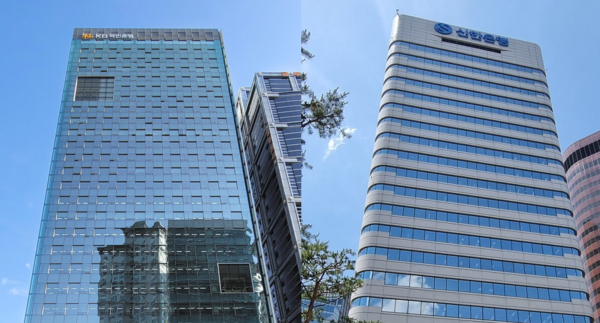
KB Kookmin Bank and Shinhan Bank, which are competing for the leading bank title, have presented different management strategies for 2026. The goal is the same, but KB Kookmin Bank is focusing on “expansion” while Shinhan Bank is focusing on “execution.”
The financial industry said on Tuesday that KB Kookmin Bank and Shinhan Bank recently disclosed their management strategies, opening this year’s contest for the leading bank title.
Both banks put productive and inclusive finance and customer trust forward as core values, but clear differences are emerging in their strategic emphasis and how they plan to carry them out. Kookmin Bank stressed growth in scale and market leadership, while Shinhan Bank highlighted its organisational and execution systems.
KB Kookmin Bank held “KB Kookmin Bank Strategy Meeting 2026” on Jan. 17 and presented “Grow with KB” as a new slogan. It aims to go beyond being No. 1 in retail finance, establish corporate finance leadership and solidify its status as the No. 1 bank through customer experience innovation.
Lee Hwan-joo (이환주), the bank’s chief executive, presented “transformation” in business and sales methods and “expansion” toward customers and new markets as key themes. He stressed a mid- to long-term vision to become the standard in the financial industry 10 years from now. Yang Jong-hee (양종희), chairman of KB Financial Group, also called for breaking away from what is familiar and expanding into new areas, urging a faster pace of change.
At the centre of KB Kookmin Bank’s strategy are “scale” and “leadership.” It plans to build on its edge in retail by expanding its influence across corporate finance and, through that, establish itself as the clear market leader.
Another notable point is that it set customer trust as a precondition for executing its strategy. It is seen as having clearly defined “trust” as the source of competitiveness, mindful of consumer protection issues across the financial sector. At the strategy meeting, it also directed staff to use nearby small business restaurants instead of providing a luncheon, which is interpreted as a message of practising inclusive finance and social value.
Shinhan Bank put forward a more concrete execution strategy with “acceleration” as its keyword. Under the strategic goal, “Finance for the future! Outstanding execution! Change we create together!” it presented five strategic directions: productive finance, customer-centric solutions, AX and DX, company-wide innovation and establishing trust. Chief Executive Jeong Sang-hyeok (정상혁) viewed execution capability, rather than direction, as the key and put emphasis on overhauling the organisation and processes across the board to achieve it.
In particular, Shinhan Bank redefined productive finance as the bank’s essential mission. It cited Shinhan Financial Group’s 110 trillion won productive and inclusive finance investment plan and stressed the “flow” and “efficiency” of funds. It also plans to overhaul sales sites by removing distinctions between service counters and reorganising around wealth management solutions to provide customers with optimal answers. Another feature of Shinhan Bank’s strategy is that it plans to pursue AI execution capability and the discovery of future revenue sources at the same time through the establishment of an AX Innovation Group and a Future Innovation Group.
Comparing the two banks’ strategies, KB Kookmin Bank is focusing on “scale and stature,” while Shinhan Bank is focusing on “systems and execution.” KB Kookmin Bank’s strategy is to quickly widen the gap by establishing corporate finance leadership and strengthening market dominance. Shinhan Bank’s approach is to build mid- to long-term competitiveness through organisational restructuring and stronger execution capability.
Both put customer trust as the top value, but there is a difference in that KB Kookmin Bank stressed it as “the source of competitiveness” while Shinhan Bank made it more concrete by extending to systems and awareness improvements such as financial security and protection of customer information.
The two banks’ strategies carry greater meaning amid the rivalry for the leading bank title. Based on cumulative net profit through the third quarter of last year, Kookmin Bank led with 3.3645 trillion won, ahead of Shinhan Bank’s 3.3561 trillion won by 8.4 billion won. Shinhan Bank had been leading through the first half, but KB Kookmin Bank overtook it in the third quarter. With the gap small, the annual leading bank title is likely to be decided by fourth-quarter results. Variables remain, including various penalty fines, provisions and one-off costs.
As a result, the key to this year’s contest for the leading bank title is expected to be the “execution capability” and “performance” of management strategies. Against the common denominator of productive finance and customer trust, whether KB Kookmin Bank’s expansion strategy leads to improved profitability and whether Shinhan Bank’s organisational innovation and AX and DX function as real competitiveness are expected to determine the leading bank title.
A financial industry official said, “Kookmin Bank is seeking a step up by expanding its reach into corporate finance based on its retail competitiveness, while Shinhan Bank’s strategy is to pursue a stable rebound by organising its organisational and execution systems.” The official added, “Not only fourth-quarter results but also, over the mid to long term, which strategy translates into performance will be the watershed in the leading bank competition.”
 Ji-young Lee
ljy@d-today.co.kr
Ji-young Lee
ljy@d-today.co.kr