
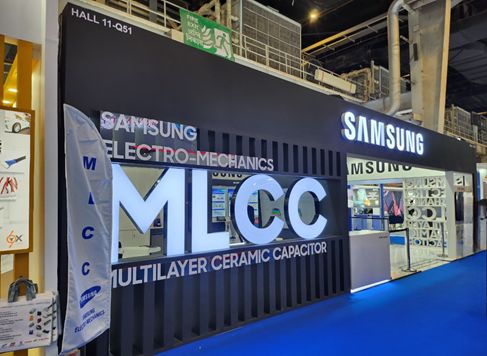
China’s controls on rare earth exports are targeting Japan’s MLCC industry, accelerating a reshaping of the global supply chain. With Japanese companies such as Murata facing production disruption risks due to heavy dependence on China for raw materials, Samsung Electro-Mechanics has emerged as an alternative.
China’s move to weaponise resources is turning toward Japan’s parts industry, heightening concern about a global supply-chain crunch. As China counters Japan’s tougher controls on exports of semiconductor equipment to China with export restrictions on key minerals such as gallium, germanium and graphite, Japanese MLCC makers that depend heavily on China for core materials such as ceramic powder and rare earth additives for internal electrodes are set to take a direct hit. Japanese MLCC makers including Murata and TDK are pursuing de-China efforts down to raw material sourcing, but a complete break is being delayed.
Against that backdrop, Samsung Electro-Mechanics’ position is gaining attention. As Japanese makers face the possibility of longer lead times due to raw material supply issues, Samsung Electro-Mechanics is effectively the only company that can supply high-capacity and automotive products in large volumes in the global MLCC market excluding Japan. Market research firms including TrendForce analysed that buyers spread orders to suppliers with higher supply stability whenever geopolitical tensions rise.
In particular, Chinese mobile device makers such as Xiaomi, Oppo and Vivo, and electric vehicle makers such as BYD, are showing moves to diversify vendors by reducing reliance on Japan and increasing their share of Samsung Electro-Mechanics to stabilise supply chains. According to influential Chinese outlets including 21st Century Business Herald, China calls for fostering domestic companies but, for now, acknowledges the technology gap in automotive and high-end IT MLCCs. IT and EV companies in China view Samsung Electro-Mechanics as the most realistic top alternative if Japan’s supply chain becomes unstable, citing proven technology capabilities.
OPPORTUNITY OPENED BY GEOPOLITICAL RISKS SIGNALS RECORD RESULTS THIS YEAR
Samsung Electro-Mechanics is seen as a supplier of high-performance products capable of competing on equal footing with Japanese makers. In automotive MLCCs, it has built technology capabilities and a portfolio on par with Japanese peers. With utilisation at leading companies including Samsung Electro-Mechanics and Murata nearing 100 percent, centred on high value-added MLCCs, the current situation allows them to screen customers and optimise product mix.
Unlike Japanese makers exposed to raw material supply risks, Samsung Electro-Mechanics has diversified production bases in South Korea, the Philippines and Tianjin, China, and has multiple raw material supply routes, iM Securities analysed. Supply-chain instability is a factor that can defend against or lift a drop in component unit prices. The outlook is that this trend will ultimately lead to improved profitability at Samsung Electro-Mechanics.
The market is also sensing the change. Samsung Electro-Mechanics shares have risen about 33 percent over the past three months and are setting a new 52-week high, while Murata, a leading company in Japan’s MLCC industry, has fallen about 7 percent from its peak in November last year, with its upward momentum slowing. Supply-chain risks are splitting the two companies’ share-price trends.
Samsung Electro-Mechanics’ market share is also expected to expand rapidly this year. With technology capabilities and a portfolio in industrial and automotive MLCCs on par with Japanese makers, any supply disruption from Japan could concentrate orders on Samsung Electro-Mechanics, according to the analysis. Chinese smartphone makers tend to prefer South Korean suppliers that are politically neutral while offering high quality amid U.S.-China and China-Japan tensions. Tesla’s plans to expand humanoid robots, robotaxis and SpaceX businesses in 2026 are also a positive factor for Samsung Electro-Mechanics.
Considering checks and tariff policies between the United States and China, attention should be paid to the possibility that reliance on Samsung Electro-Mechanics will increase, Daishin Securities said. Daishin Securities forecasts Samsung Electro-Mechanics’ 2026 revenue at 12.3 trillion won, up 9.3 percent from a year earlier, and operating profit at 1.2 trillion won, a 31 percent increase.
 Seok Dae-geon
d2dg@d-today.co.kr
Seok Dae-geon
d2dg@d-today.co.kr