
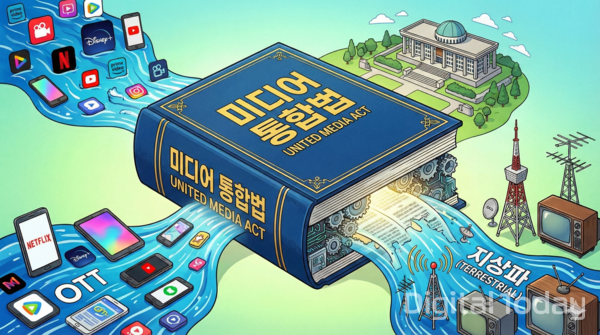
The launch of the Broadcasting Media Integration Commission, a broadcast and media integration control tower, is drawing attention to whether it will speed up debate over a “media integration law” that has drifted for more than 10 years. Even as video platforms such as Netflix and YouTube emerged, a legal system centered on terrestrial and cable broadcasting from the early 2000s has continued, repeatedly raising regulatory blind spots and fairness disputes.
On Jan. 19, the commission held an outside experts meeting at the Government Complex Gwacheon to prepare an integrated media legal framework. With Chairman Kim Jong-cheol in attendance, Lee Jong-kwan, a senior expert at law firm Shin & Kim, delivered a presentation on the need to 추진 an integrated framework in response to changes in the media environment. A panel discussion followed with Kang Joon-seok, a director at the Korea Information Society Development Institute (KISDI), Kim Nam-doo, Noh Chang-hee, head of the Digital Industry Policy Institute, Lee Nam-pyo, an adjunct professor at Kyung Hee University, and Lee Jong-won.
The meeting is known to have discussed the need for an integrated framework in response to rapid changes such as OTT and FAST (free ad-supported streaming). One participant said the aim was to draw up a roadmap for an integrated media legal framework under the commission’s first-term structure and review long-delayed tasks.
The current media bills are based on a full revision of the Broadcasting Act in 2000 that integrated terrestrial and cable broadcasting. It was created at a time when global platforms such as Netflix and YouTube did not exist. As OTT has grown rapidly and now wields influence comparable to traditional broadcasters, insufficient regulation has led to various controversies over reverse discrimination and blind spots in viewer protection.
There have been repeated attempts to enact a media integration law. In 2019, lawmaker Kim Sung-soo and others proposed an “Integrated Broadcasting Act” to bring OTT into the broadcasting system, but it was scrapped after industry backlash and the end of the legislative term. A 2023 “Audiovisual Media Services Act” pushed by the fifth Korea Communications Commission also fell through after the Ministry of Science and ICT (promotion) and the Korea Communications Commission (regulation) failed to narrow their differences.
In June last year, after the 22nd National Assembly was formed, a task force on the integrated law was launched under the leadership of Choi Min-hee, a Democratic Party lawmaker who chairs the National Assembly’s Science, ICT, Broadcasting and Communications Committee, raising expectations. But it failed to 공개 the bill in August as originally planned amid a standoff between the ruling and opposition parties over the “four broadcasting laws”.
The commission’s launch is expected to provide strong momentum for the stalled push for an integrated law. While it follows the direction of past bills in covering both new and old media and supporting industry growth, expectations are growing that detailed provisions will be differentiated under the broadcast and media integration control tower.
In a New Year address, Kim said, “We will speed up building an ‘integrated media legal framework’.” He said it would integrate and overhaul a regulatory system dispersed across separate laws to reflect the rapidly changing environment and improve regulatory fairness among media services.
The core of the integrated law envisioned by the commission’s first term is to introduce a “horizontal system” that reorganises regulation levels by the nature of services. Until now, laws and regulation have been divided by transmission media such as terrestrial, cable and IPTV. Even if they provide the same drama, terrestrial broadcasters were subject to the Broadcasting Act, while Netflix was not a regulatory target.
It would reclassify by content to align fairness. One approach would group both Netflix and terrestrial dramas as “video on demand (VOD)” and apply the same standards. YouTube Live and terrestrial live broadcasts would be classified as “real-time streaming” and subject to the same level of regulation.
Legislative will in the National Assembly and coordination among stakeholders remain tasks. An industry expert familiar with the issue stressed that “it is ultimately an issue the National Assembly must handle, but both 2015 and 2019 ended in failure. It is not a lack of discussion but a problem of legislative will.” The expert added that, given the vast ecosystem and the difficulty of coordination, discussion is needed through a social consultative body or a public-private consultative body.
Fairness in regulating overseas operators and the legal separation of public and private broadcasters, known as “public-private separation”, are also issues. An academic expert said the European Union has legislative 추진 examples in common internationally, such as regulating global big tech through the Digital Services Act (DSA) and Digital Markets Act (DMA), and said South Korea must respond in a sophisticated way. The expert argued that the role of public broadcasters should be clarified through public-private separation, while autonomy should be granted to private broadcasters.
The Science, ICT, Broadcasting and Communications Committee will hold a public hearing on the integrated media legal framework on Jan. 26, chaired by Choi.
 Seulgi Son
sageson@d-today.co.kr
Seulgi Son
sageson@d-today.co.kr