
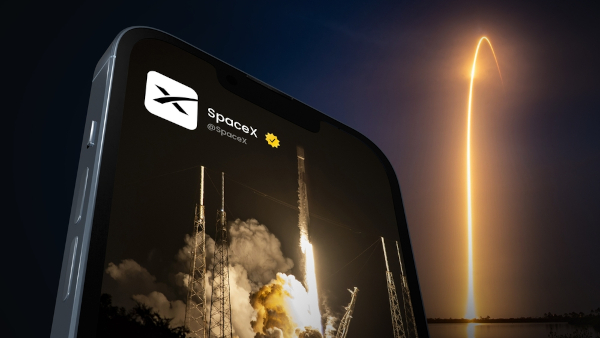
SpaceX's satellite internet service Starlink has unveiled plans to build a second-generation (V2) satellite network. The goal is to deliver speed and quality similar to terrestrial 5G networks even in satellite-connected environments.
Major foreign media outlets including IT publication Engadget reported on March 2 that Starlink Senior Vice President of Engineering Michael Nichols (마이클 니콜스) said in a keynote at the Mobile World Congress in Barcelona that Starlink Mobile aims to provide the same connectivity as on the ground when connected to a satellite system. Under the right conditions, he said, it would look and feel like being connected to a high-performance 5G network.
According to Nichols, next-generation V2 satellites can offer download speeds of up to 150 Mbps in ideal conditions. That is comparable to typical broadband speeds. V2 satellites in particular support 100 times higher data density than the previous generation. That is expected to improve streaming and web browsing speeds and further strengthen the stability of voice calls.
It is also expected to provide a more stable communications environment in remote areas such as polar regions, where traditional terrestrial network coverage is weak.
SpaceX plans to deploy more than 50 V2 satellites with each rocket launch from mid-2027. The company aims to build the next-generation constellation in about 6 months. Starlink's strategy is to sharply improve network quality as the number of satellites grows, positioning it not as a simple supplementary communications network but as a substitute for terrestrial networks.
Starlink also announced a partnership with German telecoms company Deutsche Telekom. The two companies plan to use the Starlink satellite network from 2028 to work on closing internet coverage gaps in Europe.
This is expected to provide stable internet services even in areas such as rural and mountainous regions that lack existing communications infrastructure.
Starlink's V2 satellite network shows that satellite internet is evolving beyond a simple speed upgrade to a level that can compete with terrestrial 5G. The industry is watching how much quality it can deliver in real commercial environments.
 Jinju Hong
hongjj@d-today.co.kr
Jinju Hong
hongjj@d-today.co.kr