
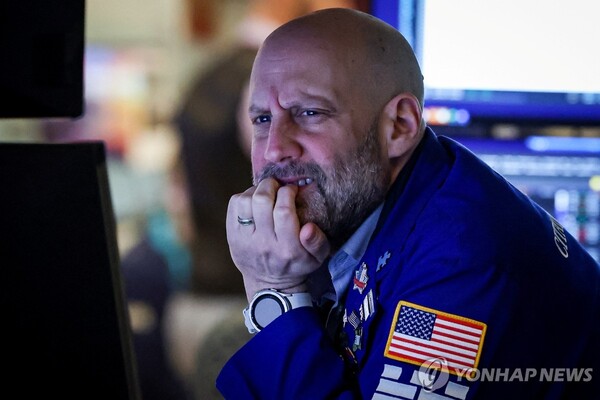
Wall Street's three main indexes ended mixed, supported by strong dip-buying.
Risk-off sentiment spread through markets after the United States and Iran entered an all-out war over the weekend. Major stock indexes opened with gap-downs.
But investors who viewed the Iran war as a given and judged it to remove uncertainty reversed the market's direction with dip-buying.
On March 2 (U.S. Eastern time) at the New York Stock Exchange, the Dow Jones Industrial Average closed down 73.14 points, or 0.15 percent, at 48,904.78.
The S&P 500 rose 2.74 points, or 0.04 percent, to 6,881.62, and the Nasdaq Composite jumped 80.65 points, or 0.36 percent, to finish at 22,748.86.
Risk-off sentiment dominated early trade. News that U.S. forces eliminated major Iranian missile facilities and top leadership over the weekend weighed on investor sentiment by adding uncertainty about the war's trajectory.
Major stock indexes opened with gap-downs. Stock index futures had strongly reflected risk-off sentiment even before the opening.
But once regular trading began, market participants interpreted the start of an all-out war between the United States and Iran as removing uncertainty. The logic was that a U.S. attack on Iran was only a matter of timing, and that once the war began there was no bigger uncertainty.
The fact that many of Iran's top leadership were killed in the first day of air strikes also helped restore sentiment. Speculation gained traction that Iran's center could wobble after Supreme Leader Ayatollah Seyyed Ali Khamenei was eliminated, a spiritual pillar of Iran's theocratic system.
Iran's Islamic Revolutionary Guard Corps blocked the Strait of Hormuz, a key global route for oil transport, but the market focused more on dip-buying. U.S. crude rose more than 12 percent intraday before paring gains to around 6 percent near the close, reinforcing the move.
U.S. Treasury yields also climbed sharply on surging oil prices and inflation worries, but stock investors paid little attention. Near-term dip-buying appeal appeared to stand out more than longer-term inflation burdens.
Jeff Kilburg (제프 킬버그), CEO of KKM Financial, said, "The stock index futures market overreacted to the Iran war, and as the S&P 500 index entered near this year's low, a buying opportunity emerged." He added, "Despite rising geopolitical tensions, we are still in a bull market."
Still, the war could be prolonged if Iran's military resists fiercely despite the loss of the regime's top leadership. U.S. President Donald Trump also said he is considering deploying ground troops, suggesting the possibility of a long war.
If instability in Iran drags on and the Strait of Hormuz blockade is prolonged, the market's approach to oil prices and inflation is likely to change. That would be a heavy burden not only for Treasuries but also for stocks.
Ross Mayfield (로스 메이필드), an investment strategist at Baird, said, "If the oil supply bottleneck (from a Strait of Hormuz blockade) persists for a long time, there will be substantial upside from current oil price levels." He added, "A two-week surge in oil prices will not affect U.S. consumers or the Federal Reserve's rate policy, but if oil prices rise over months it will have a significant impact."
By sector, energy surged 2 percent, while healthcare, consumer discretionary and consumer staples fell more than 1 percent.
Large technology companies with market capitalisation above $1 trillion were mixed. Nvidia, Apple, Microsoft, Broadcom and Tesla rose, while Alphabet fell more than 1 percent.
Palantir rose more than 5 percent as the intensifying Iran war highlighted the appeal of defence artificial intelligence.
Defence contractor Lockheed Martin also rose 3.37 percent for a second day of gains, and RTX advanced 4.71 percent.
According to CME's FedWatch Tool, the federal funds futures market priced in a 53.5 percent chance that the benchmark rate will be left unchanged through June. That jumped from 42.7 percent near the previous session's close. Inflation worries were reflected after the surge in oil prices.
The CBOE Volatility Index rose 1.58 points, or 7.96 percent, from the previous session to 21.44.
[Yonhap]
 Online Team
d-today@d-today.co.kr
Online Team
d-today@d-today.co.kr