
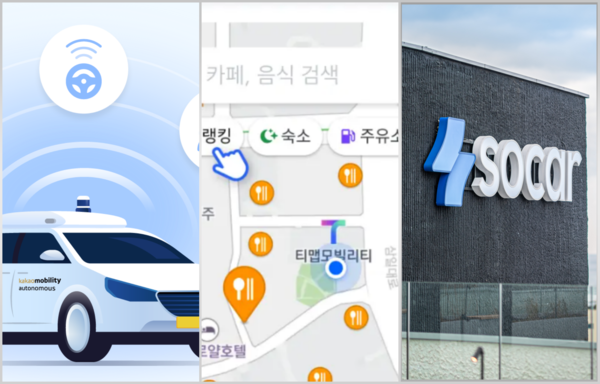
South Korea’s three mobility platforms improved profitability across the board last year. Socar recorded annual operating profit of 23.2 billion won and became the first to announce a return to the black. TMAP Mobility posted net profit of 23.3 billion won, its first annual profit since its founding, while Kakao Mobility also lifted profitability by close to 20 percent. A shared driver was winding down non-core businesses and strengthening data-based revenue models.
A keyword running through last year’s results for the three companies was “selection and concentration.” TMAP reorganised or trimmed kickboards and chauffeur services, Socar reshaped its subsidiary structure, and Kakao Mobility adjusted the share of platform services. They succeeded in a strategy of filling gaps created by cost cuts with data and AI-based revenue models.
Socar posts profit for 6 straight quarters; lifts profit per vehicle by 40 percent
Socar posted consolidated revenue of 470.7 billion won and operating profit of 23.2 billion won last year. Revenue rose 9.0 percent from a year earlier, and operating profit swung to black from an operating loss of 9.8 billion won. Fourth-quarter operating profit was 13.2 billion won, up 345 percent from the same period a year earlier at 3.0 billion won. It extended operating profitability to 6 consecutive quarters through the fourth quarter.
The key to the turnaround was maximising lifetime value (LTV) profit per vehicle under the “Socar 2.0” strategy. By using data-based demand forecasts to optimise vehicle allocation between car sharing and its monthly rental car product, Socar Plan, lifetime gross profit in revenue per vehicle rose 40 percent from before the strategy’s introduction to 14.2 million won. Annual utilisation also improved 3.1 percentage points from a year earlier to 37.8 percent.
Its accounting net loss for the period was 18.4 billion won. That reflected one-off costs of 24.8 billion won, including a debt-to-equity swap at Nine2One, a subsidiary that operates electric bicycle service Elecle. Excluding those, adjusted net profit was 6.4 billion won, an effective profit on an operating basis.
Socar will focus this year on strengthening competitiveness in its core car-sharing business and AI-based operational innovation. It also plans to build an autonomous-driving data flywheel using accumulated driving data. Socar CEO Jae-wook Park (박재욱) said, “Last year proved our structural profitability capability through improvements centred on our core business,” adding, “This year we will raise corporate value through AI-based operational innovation and investment in future mobility technologies.”
TMAP Mobility drops kickboards and chauffeur services, turns first profit with data
TMAP Mobility posted earnings before interest, taxes, depreciation and amortisation (EBITDA) of 4.4 billion won and net profit of 23.3 billion won last year, achieving profit on both measures for the first time since its founding. From a year earlier, EBITDA increased by 29.9 billion won and net profit by 100.7 billion won. Operating loss was 14.1 billion won, narrowing about 70 percent, and the operating margin improved 11.4 percentage points.
A direct cause of the profitability rebound was the disposal of non-core businesses. It ended its electric kickboard service partnered with companies including Xingxing and Gcooter, and sold its corporate chauffeur subsidiary Good Service for up to 14.0 billion won. It also sold all 6 million shares in Carrot General Insurance for 36.0 billion won. The data business filled the space left by low-profit operations that were cut.
Revenue in the mobility data and solution segment rose 35.8 percent from a year earlier. TMAP Auto revenue, from a service installed in finished vehicles, increased by more than 30 percent, and usage-based insurance (UBI) revenue linked to driving habits grew 29.4 percent. B2B data supply expanded its customer base from logistics and delivery to refining, IT and home appliances, lifting API usage by 19.3 percent.
Platform indicators also rose. Monthly active users (MAU) hit a record 15.39 million as it expanded AI place recommendations and content-style exploration functions. AI service traffic more than doubled to 5.15 million in the fourth quarter from 2.44 million in the third quarter. TMAP Mobility CEO Jae-hwan Lee (이재환) said, “A strategy to shift our business structure toward data and AI has led to tangible results,” adding, “We will strengthen a stable profit-generation structure.”
Kakao Mobility accelerates shift to physical AI as margins expand
Kakao Mobility’s performance is outlined through parent Kakao’s results. It does not disclose standalone results as an unlisted subsidiary. Based on Kakao’s consolidated results, Kakao Mobility’s revenue last year is estimated at about 770.0 billion won, with operating profit estimated at 120.0 billion won to 130.0 billion won. From a year earlier, revenue rose 15.2 percent and operating profit increased by more than 30 percent. Given the cumulative operating profit margin through the third quarter was 16.5 percent, the fourth-quarter margin is expected to rise to about 20 percent.
According to Kakao, Kakao Mobility’s business was driven by steady growth led by taxis, parking and quick services. Based on cumulative results through the third quarter, the platform infrastructure segment, including directly operated taxis and parking operation solutions, amounted to 195.1 billion won, accounting for 36.5 percent of total revenue. In particular, lifestyle service revenue, including logistics, delivery, car washing and chauffeur services, at 166.8 billion won exceeded mobility service revenue of 159.0 billion won, showing a change in the business structure. As the operating cost growth rate was below the revenue growth rate, it is expected that profit will grow further as margins improve.
The business direction is also at a turning point. Kakao Mobility this year established a new “Physical AI Division” by integrating its existing Future Mobility Development Office and Future Business Office, and brought in Jin-kyu Kim (김진규), a Korea University professor who previously worked at Waymo, as head of the division. Based on mobility data accumulated through its taxi platform and 30,000 km of driving data secured through demonstrations in 6 cities, it will develop a Korean-style end-to-end (E2E) autonomous driving model. Two cases involving allegations of preferential call allocation and accounting violations were dismissed as no charges, bringing judicial risks to a close for now.
A shared keyword is “selection and concentration”; what are this year’s variables?
The competitive landscape will diverge this year. An assessment is that the period of expanding scale while accepting losses has ended, and the companies have entered a phase in which they must increase profitability in their respective areas of strength. Kakao Mobility set physical AI and the commercialisation of autonomous driving as key tasks, TMAP Mobility set data business expansion and preparations for an initial public offering, and Socar set strengthening its core car-sharing business and achieving net profit.
 Daegeon Seok
d2dg@d-today.co.kr
Daegeon Seok
d2dg@d-today.co.kr