
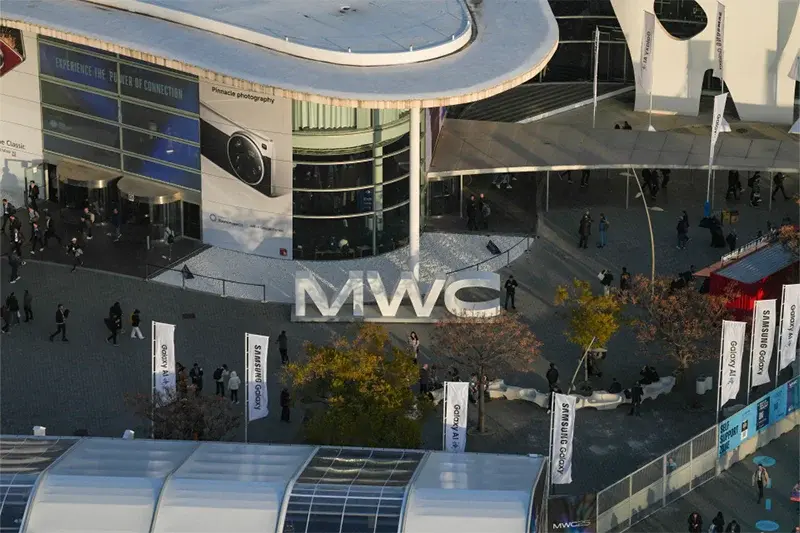
Mobile World Congress (MWC) 2026, the world’s largest mobile exhibition, opens in Barcelona, Spain, on March 2 local time for four days. This year’s MWC is expected to be a venue for an “intelligence race” as artificial intelligence (AI) spreads across telecom infrastructure and services.
The official theme for this year’s MWC is “The IQ Era.” It symbolises a turning point in which the connectivity-focused telecom industry is being reshaped into an intelligent infrastructure industry with AI built in.
The exhibition has six themes: AI 4 Enterprise, AI Nexus, Connect AI, Game Changers, Intelligent Infrastructure and Tech 4 All. Most of the themes put AI at the forefront, and there is an assessment that it effectively declares the era of a major AI transformation.
◆Global telecom heavyweights gather for keynote speeches… LG Uplus also takes the stage
Keynote sessions will feature innovation leaders in areas including networks, chipsets, satellite communications and AI platforms. Executives from SpaceX and Starlink, as well as AT&T, Nokia, Qualcomm and Rakuten Group, will discuss AI and telecom technologies. From South Korea, LG Uplus CEO Beom-sik Hong (홍범식) will deliver a keynote under the theme “Humanizing Every Connection.” This is the first time an LG Group executive has appeared as an official keynote speaker at MWC. Hong plans to introduce telecom technologies that make connections between people more valuable, using LG Uplus’ AI agent ixi-O as a topic.
South Korea’s three mobile operators are stepping up efforts to introduce their AI technologies. SK Telecom is putting forward its “full-stack AI” strategy spanning AI infrastructure, models and services. It will unveil an AI-native network combining 6G and AI-RAN, AI data centre operating capabilities and orchestration technology. SKT will join a global AI red team challenge to verify the safety and reliability of its in-house model, A.X K1, which is participating in the government’s “independent AI foundation model” project.
KT is building its exhibition space around the theme of Gwanghwamun Square and promoting Korean-style AI. As a core solution, it will unveil “Agentic Fabric,” an operating system for implementing AX optimised for corporate environments. It will also exhibit “Agentic AICC,” a next-generation contact centre solution, and “Vision Track,” which uses AI-based video analysis technology to find missing people. It will also present a physical AI strategy that connects robots, facilities and IT systems into a single intelligent ecosystem.
LG Uplus will unveil its next-generation AI data centre (AIDC) strategy, including an agentic AICC that uses OpenAI technology. LG Uplus is building a Paju AIDC with completion targeted for 2027. The Paju AIDC, being built at the largest scale in the Seoul metropolitan area, will mobilise group technologies across operations, cooling and power systems, including LG Uplus, LG Electronics and LG Energy Solution.
◆Equipment makers compete on 'AI-native networks'
Global equipment makers are welcoming visitors with AI-native technologies. Ericsson will present AI-based network automation and its strategy to advance 5G Advanced. AI-RAN technology is also drawing expectations. Ericsson has set up an exhibition hall that implements intelligent infrastructure with an immersive city concept. It is also preparing a separate display looking back at its technological development history as Ericsson marks its 150th anniversary this year.
Nokia will unveil AI-native architecture that applies AI to telecommunications and its 6G vision. It is a strategy to innovate the telecom industry through quantum technology and network automation. Huawei is expected to showcase next-generation network solutions in an approximately 1,200 square metre exhibition hall, with AI autonomously restoring faults and optimising energy.
Competition in devices is also intense. Samsung Electronics plans to exhibit its new flagship Galaxy S26 series unveiled through Unpacked. The Galaxy S26 features strengthened “agent AI” functions by linking Bixby with Google Gemini and Perplexity in combination. Xiaomi will take on Samsung head-on with the Xiaomi 17 Ultra. The Xiaomi 17 Ultra includes a triple-camera system using German Leica camera technology.
Unusual smartphones are also drawing attention. Honor, a smartphone maker that split from Huawei, plans to unveil a “robot phone” that applies a robotic arm to the device. The robot phone is known to have adopted an innovative design in which a gimbal camera protrudes, and it has attracted attention even before the event.
Displays are also a notable element. Samsung Display will exhibit smartphone organic light-emitting diode (OLED) panels that apply “Flex Magic Pixel (FMP).” As low-Earth-orbit satellite-based communications enter the commercialisation stage, satellite-terrestrial integrated network (NTN) technology and the 6G vision are also expected to be major issues.
Meanwhile, the Korea Information and Communication Technology Industry Association said about 2,800 companies from 205 countries are expected to participate in this year’s MWC. Of these, 182 are South Korean companies. There is also interest in what global alliances South Korean telecom operators, which expanded cooperation with Amazon Web Services (AWS) and Google last year, will forge. There is talk that surprise announcements are possible on strategic partnerships between the three mobile operators and big tech, and on cooperation among equipment makers.
 Jin-ho Lee
jhlee26@d-today.co.kr
Jin-ho Lee
jhlee26@d-today.co.kr